Category: Digital Marketing Services

  • Web Development for Zero-Click Search: Building Websites That Win in SGE

    Web Development for Zero-Click Search: Building Websites That Win in SGE

    In 2025, the way businesses attract customers through search engines is changing dramatically. Google’s Search Generative Experience (SGE) is ushering in the era of zero-click search, where users get answers directly on the search page instead of clicking to external websites. For web developers, digital marketers, and business owners, this shift means one thing: it’s time to adapt. To stay competitive, you must understand how to optimize websites for Google SGE 2025, design with website development strategies for zero-click search, and master SGE optimization for website visibility 2025.

    Grow Business

    Understanding Zero-Click Search and SGE

    Zero-click search is not new—Google’s featured snippets, knowledge panels, and People Also Ask boxes have been around for years. But in 2025, Google SGE takes it further by generating conversational, AI-driven answers that reduce the need for users to click through.

    For example, instead of searching “best B2B email tools” and browsing multiple blogs, users now see an AI-generated summary of top tools, ratings, and quick comparisons—right inside the search results. This is efficient for users but challenging for businesses that rely on website traffic.

    That’s why mastering SGE optimization for website visibility 2025 is critical. If your website isn’t part of Google’s generative results, you risk losing visibility, clicks, and leads.

    Why Zero-Click Search Matters for Businesses

    For businesses, zero-click search changes the game:

    1. Reduced Organic Traffic – Even if you rank high, users may never click.
    2. Greater Competition for Visibility – Instead of ten links on Page One, SGE shows fewer references.
    3. Higher Authority Threshold – Only credible, authoritative sites make it into SGE summaries.

    To overcome this, website development strategies for zero-click search must be integrated into your digital roadmap.

    How to Optimize Websites for Google SGE 2025

    The core of how to optimize websites for Google SGE 2025 lies in making your content AI-readable, authoritative, and user-focused. Here’s how:

    1. Structure Content for AI Understanding
    • Use schema markup (FAQ, How-To, Product, Review) so Google’s AI can extract structured data easily.
    • Build clear question-and-answer sections that map to user intent.
    1. Strengthen Topical Authority
    • Create in-depth content hubs around your niche topics.
    • Interlink blogs, case studies, and product pages so Google recognizes your expertise.
    1. Optimize for Conversational Queries
    • Focus on natural language queries like “what is the best CRM for startups in 2025?”
    • Use long-tail keywords such as how to optimize websites for Google SGE 2025 throughout your blogs, FAQs, and landing pages.
    1. Improve E-E-A-T (Experience, Expertise, Authoritativeness, Trustworthiness)
    • Showcase expert authors with credentials.
    • Add client testimonials, case studies, and data sources.

    These steps ensure your website is recognized as trustworthy enough to feature in SGE summaries.

    digital strategies

    Website Development Strategies for Zero-Click Search

    To adapt to the future of search, website development strategies for zero-click search must prioritize both technical SEO and content experience.

    1. Mobile-First & Voice-First Design

    Since many SGE queries are voice-driven, websites must be responsive, fast, and optimized for voice search.

    1. Interactive On-Site Elements

    If users don’t click through, make the clicks you get count. Add calculators, quizzes, chatbots, and interactive content that provide value.

    1. Faster Loading Times & Core Web Vitals

    Google rewards websites with strong Core Web Vitals—fast load times, stable layouts, and smooth interactions.

    1. Content Formats Built for SGE

    Include concise summaries, bullet lists, and AI-friendly explanations. Content that answers quickly is more likely to be pulled into SGE.

    By following these website development strategies for zero-click search, businesses can stay visible even in a clickless future.

    SGE Optimization for Website Visibility 2025

    To succeed in 2025, you need a SGE optimization for website visibility 2025 plan that goes beyond keywords.

    • Optimize for Featured Snippets & People Also Ask: These are still major entry points into SGE answers.
    • Invest in Multimedia Content: Videos, podcasts, and infographics have higher chances of being cited in generative results.
    • Focus on Semantic SEO: Cover topics in clusters, not isolated posts. Ensure every angle of a keyword is covered.
    • Update Content Frequently: SGE prioritizes fresh, relevant, and updated information.

    Ultimately, the brands that win are those that don’t just chase clicks—they chase visibility and trust.

    The Future of Zero-Click Search

    In the near future, zero-click search will dominate the digital landscape. Businesses that ignore this will struggle to generate organic traffic, while those who adopt SGE optimization for website visibility 2025 will thrive.

    The winners will be companies that:

    • Align technical SEO with AI requirements.
    • Deliver content designed for humans and machines.
    • Build websites as trustworthy knowledge hubs, not just online brochures.

    Conclusion

    The shift toward AI-driven zero-click search is here to stay. To remain relevant, brands must embrace how to optimize websites for Google SGE 2025, implement smart website development strategies for zero-click search, and stay ahead with SGE optimization for website visibility 2025.

    In 2025, the question isn’t whether zero-click search will affect your business—it’s how prepared your website is to win in SGE.
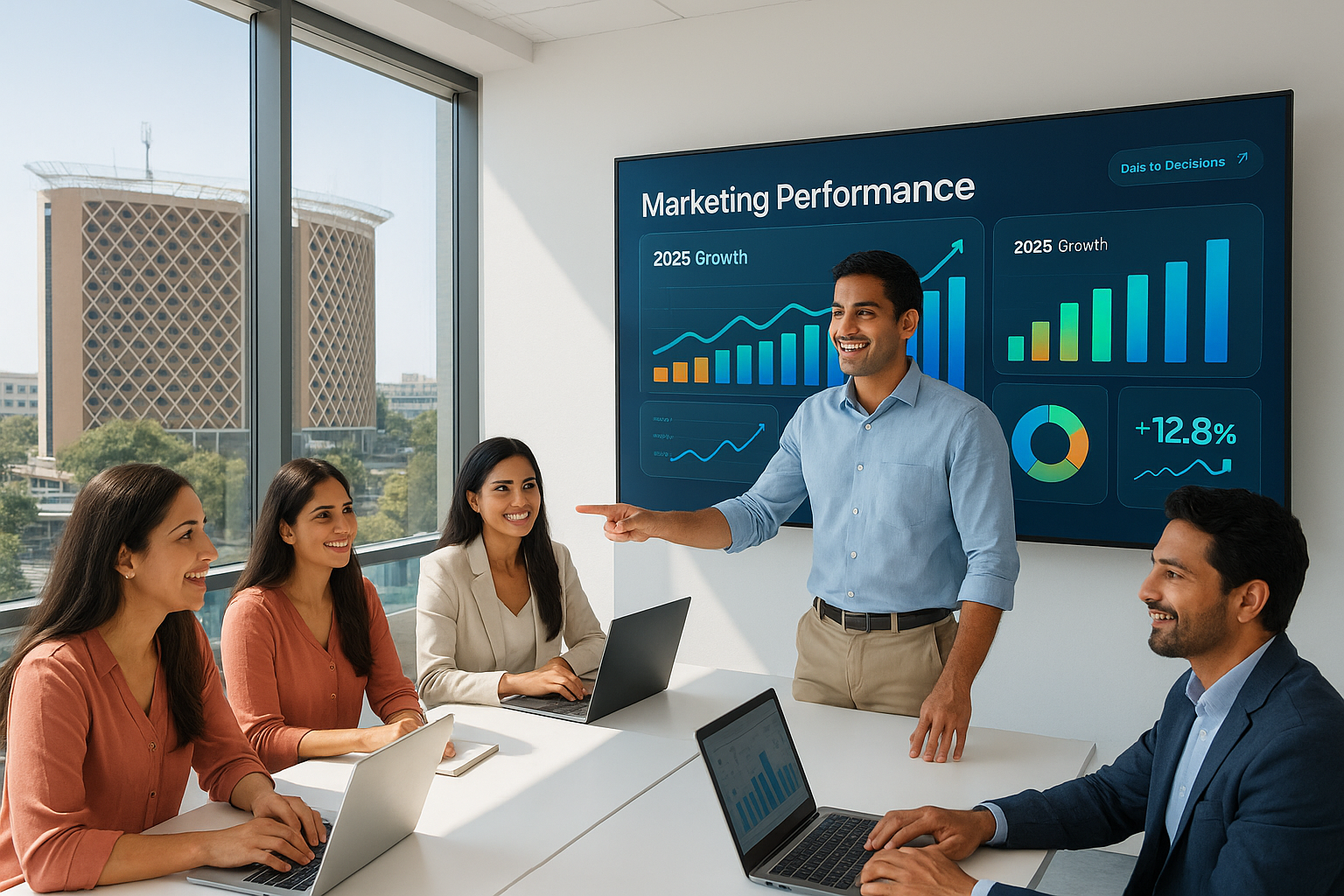

     

  • From Data to Decisions: How Marketing Dashboards Drive Growth in 2025

    From Data to Decisions: How Marketing Dashboards Drive Growth in 2025

    In 2025, digital marketing is no longer about intuition or guesswork—it’s about precision, clarity, and measurable results. Businesses that thrive are those that can translate data into decisions quickly. This is where marketing performance dashboards in Hyderabad are becoming a game-changer for brands looking to stay competitive.

    Dashboards bring together all your critical marketing metrics—traffic, leads, conversions, ROI—into one easy-to-understand visual hub. Instead of juggling multiple tools and spreadsheets, dashboards give decision-makers a single source of truth, helping them allocate budgets wisely, track campaigns in real time, and identify what’s driving growth.

    Grow Business

    Why Dashboards Are Essential in 2025

    The marketing landscape has evolved rapidly with AI, automation, and hyper-personalization. Traditional reports are too slow and static. Businesses now need:

    • Real-time insights to track campaign performance instantly.
    • Cross-channel integration to see SEO, paid ads, social media, and email results in one place.
    • Predictive intelligence to forecast which campaigns will bring the highest ROI.

    For businesses in Hyderabad—especially SMEs and startups competing in fast-moving industries—dashboards are no longer a luxury but a necessity. The ability to make data-driven decisions means fewer wasted ad spends and more qualified leads entering the funnel.

    Marketing Performance Dashboards in Hyderabad: Local Advantage

    Hyderabad has quickly become a hub for IT, SaaS, and digital-first businesses. With such a competitive environment, marketing performance dashboards in Hyderabad help companies differentiate themselves by:

    1. Benchmarking against regional trends – Dashboards reveal how your business is performing compared to local industry averages.
    2. Tracking localized campaigns – From Google Ads targeting “Hyderabad software companies” to Facebook ads for regional audiences, dashboards help track what’s resonating.
    3. Faster decision-making – Hyderabad’s B2B businesses often deal with global clients. Dashboards cut reporting time and provide instant clarity for executives managing cross-border campaigns.

    This local context makes dashboards not just a reporting tool but a competitive advantage.

    Data-Driven Decision Making in Digital Marketing Hyderabad

    In a city buzzing with tech talent and digital startups, leaders can’t rely on gut feeling alone. They need data driven decision making in digital marketing Hyderabad to survive and scale.

    Here’s how dashboards enable smarter decisions:

    • Budget allocation: Dashboards highlight the campaigns that deliver the best ROI, so marketing leaders can double down on high-performing channels.
    • Lead quality tracking: Beyond lead volume, dashboards show lead sources, conversion rates, and lifetime value, allowing businesses to prioritize channels bringing in the right customers.
    • Performance transparency: Marketing teams and leadership can align better when everyone sees the same numbers—no miscommunication, no hidden data silos.

    This kind of data-driven culture empowers Hyderabad-based companies to pivot quickly, test bold strategies, and respond to market shifts faster than competitors.

    grow business

    Best Tools for Marketing Analytics Dashboards Hyderabad 2025

    With so many tools available, choosing the right one can be overwhelming. The good news is that best tools for marketing analytics dashboards Hyderabad 2025 are now more accessible than ever, offering both affordability and enterprise-grade features. Some leading options include:

    1. Google Looker Studio (formerly Data Studio): Free, flexible, and integrates seamlessly with Google Analytics 4, Google Ads, and BigQuery.
    2. HubSpot Marketing Hub: Ideal for inbound marketers, offering dashboards for email campaigns, lead tracking, and sales alignment.
    3. Power BI by Microsoft: Popular among Hyderabad corporates for its ability to connect with ERP and CRM data.
    4. Tableau: Advanced visualization tool for businesses handling massive amounts of data.
    5. Zoho Analytics: A cost-effective choice for small to medium-sized Hyderabad businesses seeking local support and ease of use.

    Each of these tools offers integrations, AI-powered insights, and customizable reporting features that help marketers in Hyderabad cut through the noise and focus on what matters most.

    The Future of Dashboards: AI + Predictive Analytics

    In 2025, dashboards are moving beyond “what happened” to “what will happen.” AI-powered dashboards can now predict campaign outcomes, suggest optimal posting times, and even forecast lead generation trends. Imagine your dashboard not only telling you that LinkedIn ads generated 100 leads last month, but also predicting that your next campaign will generate 20% more leads if you target specific industries in Hyderabad.

    This predictive edge is what makes dashboards more than just tools—they are decision accelerators.

    Final Thoughts

    In today’s digital-first economy, making fast, confident, and precise decisions separates thriving businesses from those falling behind. For companies in Hyderabad, marketing dashboards bridge the gap between raw data and smart action. They allow leaders to visualize results, optimize campaigns, and confidently plan their next move.

    Whether you’re a startup founder, a marketing manager, or a B2B enterprise executive, investing in marketing performance dashboards in Hyderabad, adopting data driven decision making in digital marketing Hyderabad, and exploring the best tools for marketing analytics dashboards Hyderabad 2025 will put you miles ahead of competitors.

    Dashboards aren’t just about tracking numbers—they’re about driving growth. And in 2025, that growth begins with data-driven decisions.

  • Battling Google Zero: Strategies to Thrive in the Era of AI-Powered Zero-Click Search

    Battling Google Zero: Strategies to Thrive in the Era of AI-Powered Zero-Click Search

    The future of search is shifting faster than marketers imagined. With Google’s Search Generative Experience (SGE) and AI-powered results dominating page one, traditional clicks are disappearing. Welcome to the zero-click search era, where answers are delivered instantly, directly on the search results page. For brands, this is both a threat and an opportunity. The challenge now is clear: how do you build visibility, trust, and conversions when the clicks don’t come?

    This blog explores AI-driven zero click search strategies, how to optimize for Google SGE 2025, and the most effective digital marketing tactics for zero click results that help your brand stay visible, even without the click.

    Grow Business

    Understanding Zero-Click Search in 2025

    A zero-click search happens when users find the answer they need directly on Google—whether through AI snapshots, featured snippets, knowledge panels, or local packs. With SGE, this is amplified. Instead of 10 blue links, users are presented with an AI-curated response, complete with context, summaries, and even transactional recommendations.

    In 2025, Google SGE optimization isn’t optional—it’s the foundation of digital visibility. Marketers who fail to adapt risk being invisible in a landscape where AI answers replace traditional organic traffic.

    AI-Driven Zero Click Search Strategies

    The shift to zero-click doesn’t mean defeat. It means rethinking how you provide value within Google’s ecosystem itself. Here are essential AI-driven zero click search strategies for 2025:

    1. Structured Data Markup

    Use schema markup aggressively. Structured data helps Google’s AI understand your content better, making it more likely to surface in SGE summaries and featured snippets.

    1. Entity-Based Optimization

    Focus on entities, not just keywords. Google’s AI connects topics, brands, and concepts. Building authority around entities positions you as a trusted source for AI-powered answers.

    1. Content Designed for Summaries

    Break content into concise, answer-driven blocks. Lists, bullet points, and definitions feed AI models more effectively, increasing the chances of being pulled into zero-click responses.

    1. Visual Search Adaptation

    With multimodal search growing, optimize visuals with descriptive alt text and structured metadata. This is crucial as SGE integrates text + image results.

    1. Brand Mentions & E-E-A-T

    Google rewards Experience, Expertise, Authoritativeness, and Trustworthiness (E-E-A-T). Consistent brand mentions across the web build trust signals that AI prioritizes in zero-click scenarios.

    These AI-driven zero click search strategies turn visibility into influence—your content becomes part of the conversation even when users don’t land on your website.

    How to Optimize for Google SGE 2025

    If you’re wondering how to optimize for Google SGE 2025, think beyond keywords. Google’s AI doesn’t just parse phrases—it interprets intent, context, and trustworthiness. Here are practical steps:

    1. Optimize for Conversational Queries

    SGE leans heavily on natural language. Anticipate user questions in conversational formats—“What is the best CRM for small businesses?”—and craft content that directly answers them.

    1. Focus on Topical Authority

    Instead of dozens of shallow blogs, build deep topic clusters. For example, if you’re in digital marketing tactics for zero click results, cover every angle—zero-click SEO, AI snippets, brand positioning, and analytics.

    1. Leverage Long-Tail Keywords

    While head terms are competitive, long-tail queries feed directly into AI answers. Optimizing for long-tail questions ensures your content is included in SGE summaries.

    1. Integrate Multimedia & Interactive Content

    Google’s AI favors content that provides depth. Embedding videos, FAQs, and interactive tools helps secure placements in rich zero-click features.

    1. Local & Transactional Optimization

    For local businesses, optimizing Google Business Profiles and reviews is critical. SGE integrates maps, reviews, and transactions directly into the AI snapshot.

    Mastering how to optimize for Google SGE 2025 isn’t about gaming the algorithm—it’s about aligning your digital ecosystem with the way AI interprets authority and trust.

    Digital Marketing Tactics for Zero Click Results

    grow business

    Adapting to this new reality requires holistic thinking. Here are proven digital marketing tactics for zero click results:

    1. Build Brand Demand Off Google

    Relying solely on organic search is risky. Invest in email marketing, LinkedIn thought leadership, and niche communities to create demand independent of search traffic.

    1. Prioritize First-Party Data

    Zero-click search reduces traffic, meaning fewer cookies and less third-party data. Collect emails, leverage CRM strategies, and run account-based marketing (ABM) campaigns to future-proof targeting.

    1. Own the Narrative on Social Media

    When clicks decline, impressions and visibility matter more. Social content reinforces authority and pushes users to search specifically for your brand, bypassing AI-curated answers.

    1. Leverage Influencer & PR Mentions

    Mentions across media outlets and expert citations strengthen E-E-A-T signals. When AI curates results, brands with higher trust win the visibility battle.

    1. Track Zero-Click ROI Metrics

    Don’t just track traffic. Monitor impressions, brand mentions in AI answers, and assisted conversions. These reflect influence in a zero-click landscape.

    Adopting these digital marketing tactics for zero click results ensures you maintain growth even when fewer users reach your website.

    Final Thoughts

    The rise of AI-powered search doesn’t signal the death of SEO—it signals its transformation. Success in 2025 depends on mastering AI-driven zero click search strategies, knowing exactly how to optimize for Google SGE 2025, and deploying digital marketing tactics for zero click results that expand your visibility beyond clicks.

    Marketers who embrace this shift will thrive by turning zero clicks into maximum influence. Those who resist risk fading into the background while Google’s AI delivers answers without them.

  • Your Goals, Our Strategy: Building a Digital Roadmap for Growth

    Your Goals, Our Strategy: Building a Digital Roadmap for Growth

    In today’s competitive digital world, every business has ambitions. Some want to capture more leads, others want to expand brand awareness, and many want to improve conversions. But here’s the challenge: goals without a clear plan are just wishes. That’s why you need a digital marketing roadmap for business growth — a step-by-step strategy that connects your business objectives with the right online tactics.

    At Hezemon, we believe in a simple truth: You’ve got goals. We’ve got the roadmap. And that roadmap is built by aligning your marketing efforts with your long-term vision.

    Grow Business

    Why a Digital Marketing Roadmap is Essential

    Many businesses jump straight into ads, social media, or SEO without a defined path. But just like building a house, you need a blueprint before you start laying bricks. A digital marketing roadmap for business growth ensures every effort, every campaign, and every investment contributes directly to your objectives.

    Without it, marketing activities often end up scattered, with little connection to actual results. With it, your marketing becomes intentional, measurable, and scalable.

    Step 1: Align Marketing with Business Goals

    The first step in creating a roadmap is understanding how to align marketing strategy with business goals. If your goal is to increase revenue by 20% this year, your marketing shouldn’t just focus on vanity metrics like clicks or impressions. Instead, your campaigns should drive qualified leads that convert into sales.

    For example:

    • A SaaS company aiming for higher retention should design email campaigns around product onboarding and customer education.
    • A retail brand with aggressive growth targets should focus on performance marketing tied to customer acquisition costs.

    When you clearly know how to align marketing strategy with business goals, you stop chasing random opportunities and start focusing only on tactics that drive measurable outcomes.

    Step 2: Goal-Based Branding & Website Development

    Your website isn’t just an online brochure — it’s your most powerful sales tool. But is it aligned with your business goals? That’s where goal-based branding and website development strategies come in.

    • If your goal is lead generation, your website needs clear CTAs, landing pages, and conversion-focused design.
    • If your goal is brand awareness, your website should highlight storytelling, values, and thought leadership content.
    • If your goal is customer trust, your website must showcase testimonials, case studies, and social proof.

    Too often, businesses build websites that “look nice” but don’t serve their growth goals. By implementing goal-based branding and website development strategies, you transform your site into a roadmap checkpoint — guiding every visitor closer to your objectives.

    Step 3: Create Campaigns that Serve the Roadmap

    Once your goals and foundation are set, your campaigns should directly tie back to them. Here’s how a digital marketing roadmap for business growth connects channels:

    • SEO & Content Marketing → Builds authority, captures organic leads, and supports long-term brand equity.
    • Paid Ads (Google/LinkedIn/Facebook) → Drives fast, scalable traffic aligned with specific conversion goals.
    • Email & Automation → Nurtures leads and improves customer lifetime value.
    • Social Media Marketing → Increases visibility, strengthens community, and amplifies brand storytelling.

    Every campaign is not just “marketing.” It becomes a tactical step in the roadmap — each one aligned to measurable KPIs.

    Step 4: Measure, Optimize, Scale

    The beauty of a digital marketing roadmap for business growth is that it isn’t static. Markets evolve, buyer behavior shifts, and platforms change. That’s why measurement and optimization are built into the roadmap.

    By reviewing KPIs regularly, you can answer key questions:

    • Are our marketing activities driving real business growth?
    • Do we need to reallocate budgets to align better with goals?
    • Which campaigns support revenue, retention, or branding most effectively?

    This ongoing refinement keeps your roadmap relevant, ensuring your goal-based branding and website development strategies and campaigns keep delivering ROI.

    Real-World Example: A Roadmap in Action

    A mid-sized IT services firm came to us struggling with low-quality leads. Their marketing was active — ads, SEO, and social media — but none of it tied back to business growth.

    We redesigned their roadmap around three goals:

    1. Improve website conversion rate.
    2. Generate qualified B2B leads.
    3. Build trust with enterprise clients.

    Here’s what changed:

    • Their website was rebuilt using goal-based branding and website development strategies, featuring case studies and a streamlined funnel.
    • Campaigns were redesigned to demonstrate how to align marketing strategy with business goals — focusing on lead nurturing, not just clicks.
    • We executed an integrated digital marketing roadmap for business growth that connected paid campaigns with content and email automation.

    Within six months, their qualified leads doubled, and revenue grew by 28%.

    Final Thoughts

    Your goals deserve more than random marketing activities. They deserve a clear, strategic roadmap. By aligning every campaign with your business objectives, designing websites that serve outcomes, and building consistent branding, you create a digital marketing roadmap for business growth that’s actionable and measurable.

    Remember: marketing success doesn’t come from doing everything. It comes from doing the right things in the right order — always guided by your goals.

    At Hezemon, we don’t just run campaigns; we build goal-based branding and website development strategies that align with your vision. Because your growth story deserves more than chance — it deserves a roadmap.

  • Why SEO Isn’t Optional: The First Step of Every Digital Journey

    Why SEO Isn’t Optional: The First Step of Every Digital Journey

    In today’s hyper-connected world, SEO(Search Engine Optimization) isn’t just another digital marketing tactic — it’s the foundation of every digital marketing strategy. Whether you run a small business or a large enterprise, the importance of SEO in your digital presence is undeniable. A well-optimized website isn’t just about getting traffic; it’s about attracting the right audience, improving visibility, and turning clicks into customers.

    The Importance of SEO in Digital Marketing Strategy

    Your digital marketing strategy is incomplete without a strong SEO strategy. Why? Because SEO is what makes your brand discoverable. Billions of searches happen on Google every single day, and your potential customers are in those searches — looking for solutions your business can offer. If your website doesn’t appear on search engine results pages (SERPs), you’re essentially invisible.

    digital strategies

    Here’s why SEO is important for digital marketing:

    1. Increases Organic Traffic – SEO ensures your website ranks higher for relevant keywords, bringing in visitors without relying solely on paid ads.
    2. Builds Brand Credibility – Websites that rank at the top are often perceived as more trustworthy and authoritative.
    3. Improves User Experience – A good SEO strategy focuses on site speed, mobile responsiveness, and easy navigation — all factors that keep visitors engaged.
    4. Drives Long-Term Results – Unlike ads, which stop when you stop paying, SEO keeps generating traffic over time.
    5. Boosts Conversions – With targeted keywords, you attract people who are already searching for your products or services, increasing the likelihood of conversions.

    Without SEO in your digital marketing strategy, your other marketing efforts — from social media to content marketing — won’t perform to their full potential.

    How to Optimize Your Website for Search Engine Visibility

    Optimizing your website for search engine visibility is the first practical step in leveraging the power of SEO. Think of search engines like librarians of the internet — they need to understand what your content is about before recommending it to searchers.

    Digital Marketing Services

    Here’s how you can optimize your website for SEO:

    1. Conduct Keyword Research

    Keyword research is the backbone of SEO. Use tools like Google Keyword Planner, Ahrefs, or SEMrush to find the exact terms your audience is searching for. Target a mix of short-tail keywords (e.g., “digital marketing”) and long-tail keywords (e.g., “SEO best practices for business websites”) to capture both broad and niche audiences.

    1. Optimize On-Page Elements

    On-page SEO includes:

    • Meta Titles & Descriptions – Clearly describe what each page is about and include your main keyword.
    • Header Tags (H1, H2, H3) – Structure your content so search engines can easily read and rank it.
    • URL Structure – Keep URLs short, descriptive, and keyword-rich.
    • Internal Linking – Link related pages to guide users and search engines through your site.
    1. Improve Technical SEO

    Technical SEO ensures your site is fast, secure, and crawlable:

    • Use HTTPS for security.
    • Optimize images for faster load times.
    • Create an XML sitemap and submit it to search engines.
    • Fix broken links and eliminate duplicate content.
    1. Mobile Optimization

    More than half of global internet traffic comes from mobile devices. Google prioritizes mobile-friendly websites in its rankings, so ensure your site adapts seamlessly to different screen sizes.

    1. Create High-Quality Content

    Content is the heart of SEO. Publish valuable, informative, and keyword-optimized blog posts, product descriptions, and guides that directly address your audience’s needs.

    SEO Best Practices for Business Websites

    Whether you’re a local business, eCommerce store, or B2B company, following SEO best practices for business websites ensures sustainable growth:

    1. Prioritize User Intent – Understand what your audience wants and create content that provides solutions.
    2. Consistent Blogging – Fresh content signals to search engines that your site is active and relevant.
    3. Use Local SEO – If you target a specific area, optimize for local keywords and list your business on Google Business Profile.
    4. Build Quality Backlinks – Earn links from reputable websites to boost your domain authority.
    5. Monitor and Update – SEO isn’t a one-time setup. Continuously track rankings, traffic, and conversions, and update old content to maintain relevance.

    Why Ignoring SEO is Risky

    Without SEO, your website is like a store in the middle of a desert — beautifully designed but with no visitors. Paid ads might bring short-term traffic, but when your budget runs out, so does your visibility. SEO, on the other hand, builds a long-lasting presence that works 24/7.

    Investing in SEO as the first step of your digital journey ensures every marketing dollar you spend afterward — on social media, ads, or email campaigns — is amplified.

    Final Thoughts

    In the competitive digital landscape, SEO is not optional. It’s the core of every successful digital marketing strategy and the key to long-term growth. By optimizing your website for search engine visibility and following SEO best practices for business websites, you lay a strong foundation for everything else — from brand awareness to customer loyalty.


  • How to Make the Most of 6 Hours and 58 Minutes: Winning the Digital Attention War

    How to Make the Most of 6 Hours and 58 Minutes: Winning the Digital Attention War

    Every day, the average person spends 6 hours and 58 minutes online—scrolling, browsing, liking, sharing, and searching. For digital marketers, this isn’t just a statistic—it’s a battleground for attention. The attention span is short, the competition is fierce, and the stakes are higher than ever.

    To stand out in this digital chaos, your brand must master three things:

    1. How to increase brand visibility online
    2. Digital marketing strategies for higher screen time engagement
    3. Best practices to capture online user attention

    Let’s explore how you can turn those nearly seven hours into brand gold.

    Grow Business

    Why 6 Hours and 58 Minutes Matter

    Think about it: almost 7 hours of screen time per user, per day. That’s a massive window to build brand equity, drive conversions, and create loyal followers. However, with countless brands competing for the same attention, simply being present isn’t enough.

    To make those minutes truly count, your digital marketing strategy needs to be intentional, personalized, and relentlessly optimized.

    1. How to Increase Brand Visibility Online

    a. Optimize for Search (SEO)

    First and foremost, if people can’t find you, they can’t engage with you. That’s why search engine optimization remains the single most effective tactic to increase brand visibility online.

    • Use high-density keywords throughout your content. Phrases like how to increase brand visibility online, screen time engagement, and capture online user attention should appear naturally.
    • Enhance your meta tags. Your title tags, meta descriptions, and image alt texts should all reflect your core keywords.
    • Go long-tail. Instead of just “digital marketing,” try “digital marketing strategies for higher screen time engagement” to match specific search intent.

    b. Be Omnipresent on Social Media

    Today, most screen time is spent on social platforms. Therefore, your brand needs to show up frequently—and more importantly—authentically.

    • Post stories, reels, and carousels that entertain or inform.
    • Use trending audio and relevant hashtags to expand organic reach.
    • Partner with micro-influencers whose followers match your ideal customer persona.

    c. Get on Google’s Good Side

    Beyond search rankings, Google visibility plays a key role in online branding.

    • Set up and maintain a Google Business Profile with accurate info, updated visuals, and active reviews.
    • Share regular blog content and participate in forums like Quora and Reddit—but avoid spammy promotion.
    • Encourage happy customers to leave Google reviews. It not only builds trust but also boosts local SEO rankings.
    2. Digital Marketing Strategies for Higher Screen Time Engagement

    Once people find you, the next challenge is to keep them engaged. Here’s how:

    a. Behavioral Email Marketing

    Email is far from dead. In fact, it’s thriving—especially when it’s behavior-driven.

    • Trigger emails based on user actions (cart abandon, clicks, page visits).
    • Personalize subject lines and content to boost open rates.
    • Make your emails visually appealing and mobile-friendly, with clear CTAs and short, punchy content.

    b. Create Interactive Content

    If you want your audience to spend more time with your brand, don’t just talk at them—talk with them.

    • Launch interactive quizzes, polls, or assessments.
    • Host live sessions on Instagram or LinkedIn featuring thought leaders or your internal experts.
    • Introduce gamified experiences in your app or website (e.g., badges, leaderboards, spin-the-wheel discounts).

    c. Use Short-Form Video to Your Advantage

    Today, video dominates screen time—especially short-form content. Platforms like TikTok, Instagram Reels, and YouTube Shorts are perfect for delivering bite-sized brand stories.

    • Keep videos under 60 seconds for higher completion rates.
    • Grab attention in the first 3 seconds with a hook or bold visual.
    • Always close with a strong call-to-action (CTA).

    Pro tip: Add subtitles. A staggering 85% of videos are watched without sound.

    digital strategies

    3. Best Practices to Capture Online User Attention

    Now that you’ve attracted and engaged your audience, how do you hold their attention?

    a. Follow the 3-Second Rule

    You have 3 seconds to make a first impression—so make it count.

    • Lead with strong, curiosity-driven headlines like “You’re Wasting 6 Hours Online—Here’s How to Use Them Better.”
    • Use emojis, bullet points, and bold formatting for quick scanning.
    • Eliminate unnecessary fluff and get to the value fast.

    b. Prioritize Personalization

    Generic is forgettable. Personalized content is sticky.

    • Segment your audience based on behavior, interests, or past purchases.
    • Use dynamic content and remarketing ads to show users exactly what they care about.
    • Recommend products or services based on browsing history or previous actions.

    c. Speed Is Everything

    Finally, remember: slow sites = lost attention.

    • Your website should load in under 3 seconds, especially on mobile.
    • Avoid annoying popups or auto-play features that disrupt UX.

    Use smart layout design—highlight CTAs, keep visuals clean, and guide users with a clear visual flow.

    Final Thoughts: Time Is the New Currency

    In today’s digital economy, attention is more valuable than money. And with nearly 7 hours of screen time at stake, your brand has a huge opportunity to capture, engage, and convert.

    To make the most of it:

    • Double down on how to increase brand visibility online through search and social.
    • Apply digital marketing strategies for higher screen time engagement like interactive content and video.
    • Implement best practices to capture online user attention, including speed, personalization, and compelling content.

    You don’t need to be the loudest brand—just the smartest. Win the digital attention war by showing up, standing out, and speaking directly to your audience’s needs.


  • From Invisible to Unstoppable: How One Brand 3Xed Leads with an Integrated Digital Strategy

    From Invisible to Unstoppable: How One Brand 3Xed Leads with an Integrated Digital Strategy

    In today’s digital world, showing up online is not enough. You also need to stand out and convert.

    Unfortunately, many B2B brands face the same challenge. Their SEO, email marketing, paid ads, and website design operate in silos. As a result, their marketing feels disconnected and inconsistent.

    The outcome? Low visibility, wasted budget, and underperforming lead generation.

    This is exactly where integrated digital marketing can change the game.

    In this B2B digital marketing case study, we’ll show how one mid-sized SaaS company tripled its qualified leads in six month by aligning all digital channels under a single strategy.

    Grow Business

    Scattered Tactics, No Strategy

    Our client was a B2B SaaS provider offering employee performance software. Although the product had strong capabilities, their digital visibility was weak.

    Here’s what wasn’t working:

    • Their SEO lacked structure and keyword intent
    • Email marketing was inconsistent and unsegmented
    • Paid ads ran without tracking or alignment
    • Their website design failed to build trust or drive action

    Despite spending on multiple marketing activities, they were not seeing real results. Therefore, they didn’t need more tools—they needed a clear, connected strategy that worked across all channels.

    How We Built an Integrated Digital Marketing Strategy

    To solve this, we developed a unified plan across all key digital touchpoints. This included:

    • SEO
    • Email marketing
    • Paid advertising
    • Brand design and messaging

    Each channel supported the next. Consequently, we created a lead-focused marketing engine with compounding results.

    Microsoft Office 365 Reseller

    1. SEO Overhaul: Driving Organic Traffic That Converts

    We began by optimizing their SEO strategy. The main goal was to attract bottom-of-funnel traffic and improve technical performance.

    Our approach:
    • Created blog posts targeting high-intent keywords like OKR tracking tools and performance review software
    • Enhanced Core Web Vitals and page speed
    • Linked blog content to demo and service pages for better navigation and conversion
    Result:

    As a result, organic traffic grew by 64% in just 90 days.

    Why it worked:

    Instead of only bringing in visitors, SEO became a dependable source of qualified B2B leads.

    2. Email Marketing: From Blasts to Targeted Journeys

    Next, we revamped their email content strategy. Rather than sending the same message to everyone, we introduced segmentation and behavior-based journeys.

    What changed:
    • New leads received a five-step onboarding sequence
    • Inactive leads were re-engaged based on past activity
    • Newsletters were built from blog content to reinforce SEO
    Results:
    • Open rates jumped from 17% to 31%
    • Reply rates more than doubled
    Takeaway:

    When emails are relevant, segmented, and timely, they perform significantly better—even in B2B.

    3. Paid Ads and Retargeting: From Guesswork to Precision

    Previously, their paid ads lacked direction and proper measurement. Therefore, we paused the existing campaigns and launched a full-funnel strategy instead.

    What we did:
    • Used LinkedIn Ads to target decision-makers by job title and industry
    • Ran Google Ads aligned with SEO keywords
    • Created Facebook and Instagram retargeting campaigns to re-engage visitors

    In addition, we redesigned all ad creatives to ensure visual and message consistency.

    grow business

    Results:
    • ROAS increased from 1.8x to 5.2x
    Why it worked:

    By aligning paid ads with both SEO and email messaging, we created a seamless experience that converted more leads.

    4. Design and Messaging: Building Trust at Every Touchpoint

    We also refreshed the brand’s design to boost credibility and increase conversion rates.

    Improvements included:

    • Strong CTAs across every landing page
    • Testimonials and client logos to build trust
    • Consistent visual design across emails, ads, and website

    Unified message across channels:

    “Modern performance management, made easy.”

    Why it matters:

    A clear and cohesive design reinforces trust, which is crucial in B2B lead generation.

    The Results: Real Growth in Just 6 Months

    The integrated strategy delivered measurable and compounding growth across all metrics:

    • 3X increase in qualified leads
    • 64% increase in organic traffic
    • 5.2X return on ad spend (ROAS)
    • 2X boost in email engagement
    • 35% drop in bounce rates on landing pages
    Each channel amplified the next:
    • SEO brought in high-intent visitors
    • Email nurtured and converted those leads
    • Ads retargeted and reactivated users
    • Design built trust and improved conversion rates

    Why Integrated Marketing Works in B2B Lead Generation

    This case study proves a clear point: disconnected marketing tactics don’t scale.

    To grow consistently, every channel—SEO, email, paid ads, and design—must align under one strategy.

    Key benefits of integrated marketing:
    • Improved performance across all platforms
    • Lower cost per lead and better ROI
    • Unified brand message and experience
    • Easier tracking with shared analytics
    • Scalable lead generation model

    Final Takeaways for B2B Marketers

    If you want to generate consistent leads, focus on these proven steps:

    1. Align your SEO, email, and ads under one strategy
    2. Use behavior-based email workflows for nurturing
    3. Maintain consistent branding across all touchpoints
    4. Run paid ads that reinforce your organic messaging
    5. Measure performance across all channels in one dashboard

    With a well-structured, integrated approach, your brand won’t just get traffic—it will gain qualified B2B leads and sustainable growth.


  • One Brand. One Strategy. One Team: The Power of Unified Services

    One Brand. One Strategy. One Team: The Power of Unified Services

    In today’s ultra-competitive digital world, many businesses juggle multiple vendors—one for web design, another for branding, and yet another for social media. The result? Disconnected messaging, missed deadlines, and inconsistent brand identity.

    That’s why more companies are realizing the full-service agency benefits for business branding.

    Instead of hiring separate teams, modern businesses are choosing an all-in-one creative team for brand success—a unified group that delivers integrated design, development, and marketing services under one cohesive strategy.

    The Full-Service Advantage: Everything Under One Roof

    A full-service agency offers a wide range of creative and digital solutions, including:

    • Website design and development

    • Branding and identity creation

    • SEO and content strategy

    • Social media marketing

    • Paid advertising and performance analytics

    The real value lies not just in offering all services, but in how seamlessly they work together. The full-service agency benefits for business branding extend far beyond convenience—they ensure your messaging, visuals, and campaigns are aligned from start to finish.

    Grow Business

    Unified Thinking Creates Brand Consistency

    When designers, developers, and marketers collaborate under one roof, the output is consistent, clear, and results-driven. Businesses that are choosing an all-in-one creative team for brand success gain access to:

    • Stronger brand clarity

    • Faster execution across campaigns

    • Fewer communication breakdowns

    • Better return on investment (ROI)

    This kind of synergy enhances the effectiveness of integrated design, development, and marketing services, making your brand voice consistent across all platforms.

    Real-World Example: How One Brand Rebuilt with Unified Services

    A mid-sized real estate firm in Hyderabad was working with four different vendors—one for their website, another for SEO, a third for branding, and a fourth for paid ads. The result?

    • A poor user experience on their site

    • Inconsistent visual identity across platforms

    • Low lead conversion rates

    After partnering with a full-service agency that offered integrated design, development, and marketing services, the transformation was immediate:

    • Website speed improved by 60%

    • Branding became more polished and professional

    • Ad campaign ROI increased 4X in just three months

    This is a clear example of the measurable full-service agency benefits for business branding.

    Breaking Down the Power of Integrated Services

    Let’s explore how each service contributes to your brand success when unified:

    1. Design
    Your brand’s visual elements are consistent and on-message across all assets—web, print, and digital.

    2. Development
    Developers build websites and platforms that are optimized for performance, speed, and user experience—while aligning closely with marketing goals.

    3. Marketing
    Marketers leverage design and tech insights to craft campaigns that speak to your audience and convert effectively.

    This type of cross-functional collaboration only comes with integrated design, development, and marketing services, and it’s a major reason why brands are choosing an all-in-one creative team for brand success.

    The Risks of Using Multiple Vendors

    Working with separate agencies or freelancers can lead to:

    • Creative misalignment

    • Duplicated efforts and wasted budget

    • Lack of accountability

    • No centralized KPIs or reporting

    These are issues that full-service teams eliminate. The full-service agency benefits for business branding include more control, transparency, and unified execution.

    Why Growing Businesses Need Unified Services

    As your business grows, so does the need for consistency. Whether you’re a SaaS startup or a traditional company expanding into digital, you need integrated design, development, and marketing services that scale with you.

    From landing pages to ad creatives, everything should feel like it comes from one brand voice. This cohesion builds credibility and trust with your audience—and it’s exactly why forward-thinking companies are choosing an all-in-one creative team for brand success.

    Signs You’re Ready for a Full-Service Team

    Consider making the switch if:

    • Your messaging feels inconsistent across channels

    • You’re constantly coordinating between freelancers or agencies

    • Campaigns are slow to launch

    • You’re not seeing enough ROI from your marketing

    In these cases, the full-service agency benefits for business branding can make a major difference in both performance and peace of mind.

    Conclusion: One Brand. One Strategy. One Team.

    Your brand isn’t just a logo or a website—it’s the total experience your audience has with your business. From the first Instagram ad they see to the form they fill out on your site, everything must feel consistent, clear, and compelling.

    That’s only possible with integrated design, development, and marketing services powered by a unified team. If you’re serious about scaling your brand and standing out in your industry, it’s time to start choosing an all-in-one creative team for brand success.

    When every part of your brand works together, the results are not just better—they’re transformational.

  • Why Your Facebook Ads Aren’t Converting (And What Global Marketers Do Differently)

    Why Your Facebook Ads Aren’t Converting (And What Global Marketers Do Differently)

    Running Facebook ads can often feel like throwing darts in the dark—sometimes they hit, but more often, they miss. If your campaigns look professional but still aren’t turning viewers into buyers, you’re not alone. Let’s explore the reasons why Facebook ads fail to convert and how global marketers consistently get better results.

    1. You’re Targeting the Wrong Audience

    One of the top reasons why Facebook ads fail to convert is poor audience targeting. While Facebook offers advanced targeting options—demographics, interests, behaviors, and custom audiences—many advertisers cast too wide a net or skip audience testing entirely.

    Global marketers understand that refined segmentation is essential. They create lookalike audiences, leverage retargeting, and constantly A/B test different audience profiles to boost relevance and results.

    Facebook advertising tip for higher ROI:
    Use custom audiences from website visitors or email subscribers, and build lookalike audiences to scale your conversions more effectively.

    Grow Business

    2. Your Creative Isn’t Scroll-Stopping

    In a sea of content, you have just a few seconds to capture attention. A common Facebook ad mistake to avoid is relying on generic stock images, low-quality visuals, or bland copy.

    High-performing marketers focus on native-looking visuals and localized messaging. They use platform-specific formats like video ads, carousels, and UGC (user-generated content) to create high engagement.

    Facebook advertising tip for higher ROI:
    Use short, thumb-stopping videos with strong hooks in the first 3 seconds. Test multiple copy angles to find the one that connects emotionally with your audience.

    3. Weak or Missing Call-To-Action (CTA)

    Another common reason why Facebook ads fail to convert is a weak or unclear CTA. If you don’t clearly tell users what to do next, they won’t act. “Learn More” is often too vague to be effective.

    Top marketers use direct, action-driven CTAs like “Shop Now,” “Claim 50% Off,” or “Download the Guide,” which lead to significantly higher conversions.

    Facebook advertising tip for higher ROI:
    Align your CTA with your sales funnel stage. Use softer CTAs like “Learn More” for cold leads and stronger ones like “Buy Now” or “Get the Offer” for warmer audiences.

    Digital Marketing Services

    4. Poor Landing Page Experience

    Even if your ad is excellent, sending traffic to a poorly designed or slow-loading landing page will kill conversions. A common Facebook ad mistake to avoid is not optimizing the post-click experience.

    Global marketers ensure their landing pages are mobile-friendly, fast, and aligned with the ad’s messaging and visuals. This consistency builds trust and reduces bounce rates.

    Facebook advertising tip for higher ROI:
    Use dynamic landing pages that match the ad headline and visuals. Add trust elements like reviews, badges, or testimonials to improve credibility.

    5. Lack of Testing and Optimization

    One of the easiest reasons why Facebook ads fail to convert is simply not testing enough. Too many businesses run a single version of an ad and hope for results.

    Global advertisers treat Facebook campaigns as experiments. They test variations of images, copy, headlines, CTAs, and even delivery times to identify what actually works.

    Facebook advertising tip for higher ROI:
    Always test at least 3–5 ad variations per campaign. Use Facebook’s built-in A/B testing tools to make data-driven decisions.

    Microsoft Office 365 Reseller

    6. Poor Offer Positioning

    Even great ads won’t convert if the offer isn’t compelling. A common Facebook ad mistake to avoid is promoting an aggressive sales message to a cold audience.

    Savvy marketers understand the buyer journey. They build value-first funnels using educational content, lead magnets, or free trials before pushing for a purchase.

    Facebook advertising tip for higher ROI:
    Segment your funnel into TOFU (top of funnel) and BOFU (bottom of funnel) stages. Use TOFU ads for awareness and nurture warm leads with stronger offers at the BOFU stage.

    7. Ignoring Analytics and Attribution

    You can’t fix what you can’t measure. A major reason why Facebook ads fail to convert is ignoring key performance metrics like ROAS (return on ad spend), CPA (cost per acquisition), or ad frequency.

    Global marketers rely on tools like Meta Pixel, Google Analytics, and UTM parameters to gain full-funnel visibility and optimize for real business outcomes—not vanity metrics.

    Facebook advertising tip for higher ROI:
    Track CPA, ROAS, and conversion rates, not just likes or clicks. These are the metrics that matter when it comes to business growth.

    Conclusion: Learn from the Pros, Fix the Basics

    If your Facebook ads aren’t delivering the results you hoped for, take heart—you’re not alone. The platform is powerful, but also easy to misuse. By recognizing the common Facebook ad mistakes to avoid and understanding the real reasons why Facebook ads fail to convert, you can significantly improve your campaigns.

    What sets global marketers apart isn’t a massive budget—it’s a smarter, more strategic approach. They test relentlessly, prioritize audience relevance, and focus on every step of the funnel—from the ad creative to the landing page and beyond.

    The next time you launch a campaign, revisit this checklist. Apply these Facebook advertising tips for higher ROI, measure what matters, and never stop optimizing.

  • From Scroll to Stuck: 7 Psychology-Backed Tricks to Make Viewers Watch Your Videos Till the End

    From Scroll to Stuck: 7 Psychology-Backed Tricks to Make Viewers Watch Your Videos Till the End

    If you’re tired of your audience dropping off halfway through your videos, you’re not alone. In a world filled with endless scrolling and shrinking attention spans, creators and marketers are constantly asking: how to increase video retention on YouTube?

    The answer lies not just in flashy editing — but in psychology.

    Below are 7 psychology-backed tricks that transform casual viewers into committed watchers — and keep them hooked until the very end.

    Grow Business

    1. Use Open Loops in the First 10 Seconds

    Ever wondered why cliffhangers work so well in TV shows? That’s the open loop effect — a psychological tactic that leaves viewers hanging and craving closure.

    In video terms, this means teasing a mystery, surprise, or question at the very beginning. Try lines like:

    • “You won’t believe what happened next…”

    • “At the end, I’ll reveal something that changed everything…”

    These phrases tap into the brain’s natural urge to resolve tension — one of the most powerful psychology tips for creating viral videos.

    2. Chunk Information with Visual Cues

    Humans process and retain information better when it’s delivered in small, structured pieces — or chunks.

    Use:

    • Numbered lists

    • Bold headings

    • Icons or animations

    For example, instead of a 5-minute ramble on marketing trends, break it down into “3 killer trends for 2025,” and label each clearly.

    This is one of the most effective yet underrated video content strategies to boost engagement, especially for tutorials and explainers.

    Digital Marketing Services

    3. Show Faces and Maintain Eye Contact Early

    The human brain is hardwired to respond to faces — especially eye contact. To understand how to increase video retention on YouTube, you must build connection.

    Talk directly to the camera with emotion, facial expression, and eye contact. Even AI-generated avatars that simulate eye contact outperform faceless narrations.

    4. Leverage the Zeigarnik Effect

    The Zeigarnik Effect says people remember unfinished tasks better than completed ones. In your video, present a goal or promise that won’t be fulfilled until the end.

    Example:
    “I’ll show you 3 editing hacks, and the last one will save you hours in post-production.”

    This is a classic psychology tip for creating viral videos — and it works like magic.

    5. Use Fast Cuts and Pattern Interrupts

    When viewers expect something predictable, their attention drops. Break the pattern.

    Inject energy by adding:

    • Quick camera cuts

    • Zooms and pans

    • Animated text pop-ups

    • Humor, memes, or sound effects

    These are powerful video content strategies to boost engagement by keeping the brain stimulated.

    Microsoft Office 365 Reseller

    6. Add Progress Indicators and Verbal Teasers

    Another tactic for how to increase video retention on YouTube is to signal progress and tease what’s coming next.

    Try:

    • Visual progress bars

    • Statements like:

      • “We’re halfway there, now it gets interesting…”

      • “Coming up next: the one trick nobody tells you.”

    Humans love to know where they are in a process — it’s motivating.

    7. End with Emotional Resonance

    People may forget what you said, but they’ll remember how your video made them feel. End on a powerful emotional note — shock, inspiration, laughter, or empathy.

    Why? Emotional content is:

    • More memorable

    • More shareable

    • More likely to boost YouTube session time

    And remember — emotion is at the heart of all psychology tips for creating viral videos.

    Bonus Tip: Use Data to Refine What Works

    Once you’ve implemented these tactics, head to your YouTube Analytics to improve even further.

    Check:

    • Audience Retention Graph

    • Drop-off points

    • Top-performing intros

    • A/B test titles and hooks

    Even the smartest video content strategies to boost engagement need regular tweaking. Psychology gives you the tools, but the data tells you the truth.

    Final Thoughts

    Mastering how to increase video retention on YouTube is less about tricks — and more about understanding your viewer’s mind.

    By combining structured visuals with proven psychology tips for creating viral videos, you’re not just capturing attention — you’re holding it.

    So, the next time someone presses play on your content, don’t just entertain them… engage them till the very end.