Author: hezemon_admin

  • Meeting-Room Identity: Decks That Win Enterprise Rooms

    Meeting-Room Identity: Decks That Win Enterprise Rooms

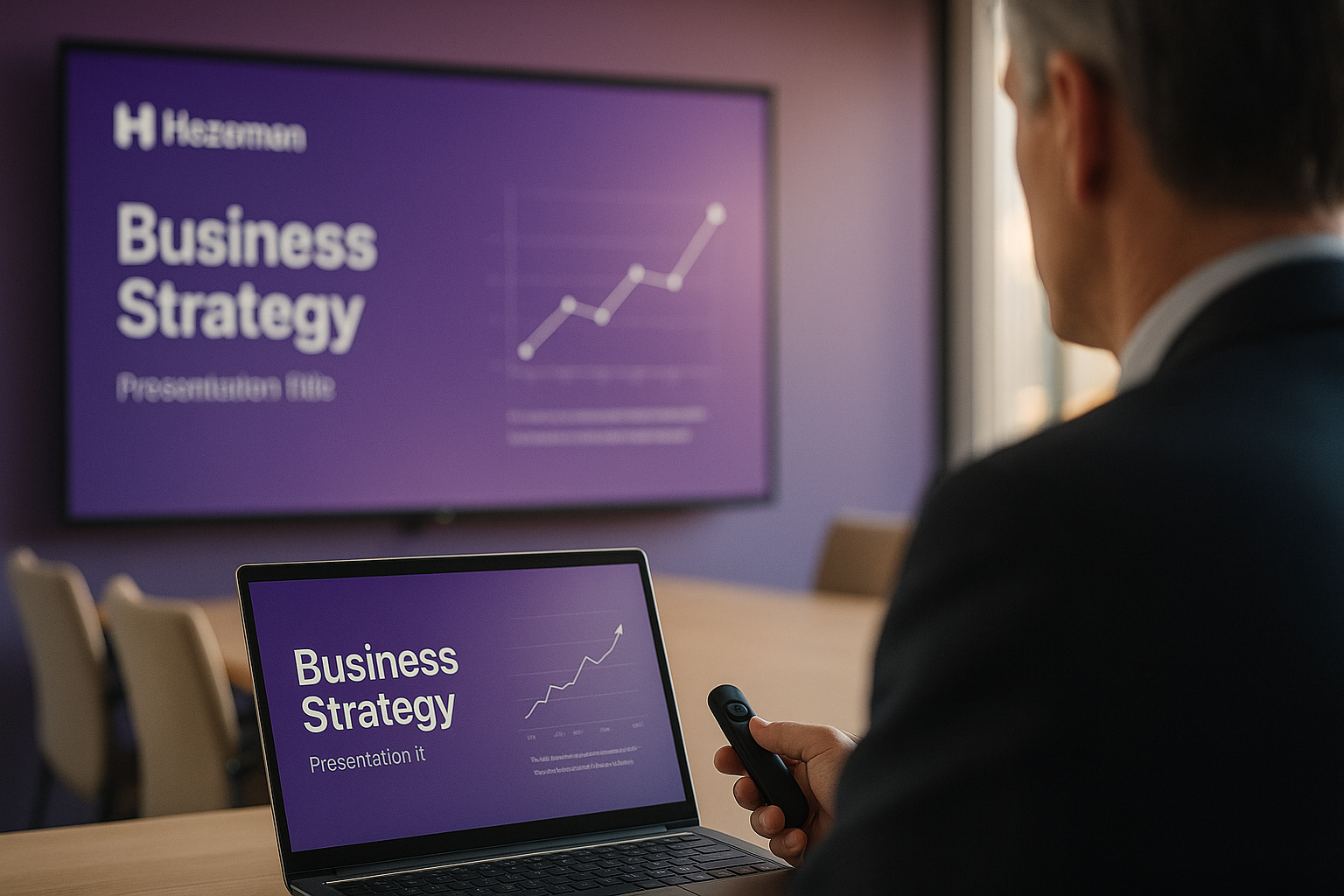
    In enterprise sales, your brand isn’t experienced first on a billboard or a homepage—it’s experienced in 30 minutes around a conference table. That moment is your meeting-room identity: the story, structure, and visual discipline your team carries into every room. At Hezemon Technologies, we’ve seen great solutions lose momentum because their decks felt like brochures, not decisions. This article distills a practical approach—rooted in a sales deck branding case study mindset—to design decks that move senior stakeholders from polite interest to committed next steps.

    Why “meeting-room identity” beats “pretty slides”

    Enterprise buyers don’t remember everything you show; they remember the few things that change their mind. Meeting-room identity is the system that makes those few things unavoidable:

    • One Big Idea per slide so executives can quote you after the meeting.
    • Proof before promises, because committees trust evidence, not adjectives.
    • Logo discipline and a coherent visual system that signal craft and reliability.
    • Predictable rhythm (visual → text → visual) to keep attention without fatigue.

    When this system is consistent across pre-reads, live decks, and follow-ups, the room experiences your brand as clarity and control.
     

    SEO Services

    The five-beat narrative spine

    Great enterprise decks follow a tight, predictable arc. Use these beats as slide sections:

    1. Hook (What’s changed?)

    Lead with the market shift, risk, or missed upside that reframes the buyer’s status quo. One slide. One sentence. Make it felt.

    1. Reality (Why now?)

    Show data, screenshots, and user quotes that prove the problem is active inside *their* world. This is where your **b2b proof assets that close deals** begin to appear (benchmarks, audits, logs).

    1. Insight (What others miss)

    Articulate a non-obvious truth that explains why current approaches fail. Your POV should be simple enough to sketch on a napkin.

    1. Framework (How it works)

    Draw your method in three to five steps—clear inputs, outputs, and time boxing. Replace jargon with verbs.

    1. Outcomes + CTA (What we’ll own together)

    Commit to measurable outcomes and next steps. Reduce friction: propose a scoped pilot, limited seats, or a 30-day sprint.

    Enterprise pitch presentation design tips that actually close

    Here are practical enterprise pitch presentation design tips you can apply today:

    • Decide the takeaways first. List the three sentences you want repeated after you leave. Design slides to earn those sentences.
    • Kill the laundry list. Cap bullets at three per slide; each line must end in an outcome, not a feature.
    • Make numbers legible at the back of the room. Headline metrics at 48–60px equivalents; annotate how they were measured.
    • Stage proofs like a courtroom. Present claim → exhibit → impact on buyer. Keep raw exhibits in an appendix for tough questions.
    • Narrate transitions. Title slides with verbs (“Cut false-positive alerts by 43%”) rather than nouns (“Alert Reduction”).
    • Prototype the talk-track. Record a dry run. If a slide takes more than 60 seconds to explain, split it or cut it.
    • Design for handoffs. Every slide should be understandable without you. Busy rooms forward decks—assume you won’t be there.

    The proof stack: assets that earn green lights

    Senior committees say yes when risk feels managed. Build a modular proof stack you can reorder based on the room:

    • Before/After telemetry: dashboards, latency charts, deliverability curves, cost-to-serve deltas.
    • Environment screenshots: redacted Teams/SharePoint, SIEM, or M365 Defender traces to show real integration.
    • Pilot summaries: one-pager per pilot with hypothesis, setup time, 30-day outcomes, and quotes from champion + skeptic.
    • Compliance evidence: DPDP/GDPR mappings, SOC2 scope notation, data-flow diagrams, DPA templates.
    • Security assurance kit: threat models, CIS/NIST control maps, pen-test extracts, SBOMs where relevant.
    • Commercial signals: time-to-value clock, procurement timeline, and a mutually-agreed success metric.

    Treat these as b2b proof assets that close deals, not appendices to be ignored.

    A mini sales deck branding case study (Hezemon playbook)

    A Hyderabad-based IT services firm had strong delivery but flat win-rates on enterprise pursuits. Their deck opened with credentials, buried outcomes, and ended with a vague “Let’s connect.” We re-engineered the meeting-room identity:

    • Narrative reset: Opened with “Your backlog isn’t capacity—it’s clarity.” Then showed a before/after timeline from a look-alike client.
    • Framework clarity: A 3-step sprint model: Assess (5 days) → Build (10 days) → Prove (15 days), with artifacts per step.
    • Proof first: The third slide was a stacked bar chart of ticket resolution time dropping 41% across three sprints.
    • Security-assured selling: Mapped their approach to CIS Controls and included a pre-filled DPA to reduce legal unknowns.
    • CTA precision: A 30-day fixed-fee pilot with named roles, weekly ceremonies, and a go/no-go date on slide one.

    Result: shorter committee cycles, more multi-stakeholder calls, and a measurable lift in proposal acceptance. This is the essence of a sales deck branding case study: don’t just beautify—reposition the buying moment.

    Slide-by-slide skeleton you can steal

    1. Title (Outcome-led) – The one sentence you want repeated.
    2. Market Shift – One chart or quote that creates urgency.
    3. Evidence It’s Happening Here – Their world mirrored back.
    4. Why Current Approaches Fail – Name the pattern.
    5. 5. Your Framework – Visual, 3–5 steps, inputs/outputs.
    6. Proof in Environments Like Yours – Logos redacted, metrics highlighted.
    7. Security & Compliance Fit – Controls mapping + data flow.
    8. Commercial Simplicity – Pilot scope, price band, timeline.
    9. Next Steps – Date, agenda, artifacts list.
    10. Appendix (For tough questions) – Deep exhibits, references, SLA terms.

    Common mistakes that quietly kill deals

    • Over-credentialing. Five slides on awards signals insecurity; one crisp credibility slide is enough.
    • Feature sprinting. Racing through 20 features dilutes the one that matters.
    • Proof in the appendix only. If evidence is hidden, it isn’t part of the story.
    • Cluttered visuals. If a CFO can’t snap a photo of your metric and text it to the CEO, it’s not clear enough.
    • Weak CTA. “Let us know” is not a next step. Offer a calendar slot and a pilot boundary.

    Bringing it together

    Winning the room is an operations problem disguised as design. When your deck system is built on a clear narrative, staged evidence, and a friction-free CTA, committees stop debating if and start discussing how. That’s what a strong meeting-room identity does—turns slides into decisions.

    If you want Hezemon Technologies to transform your deck into a repeatable, brand-true meeting-room identity, we’ll start with a discovery interview, rebuild your proof stack, and ship a pilot-ready deck in two weeks—so your next enterprise room hears, remembers, and commits.

     

  • The Future of Work: How Microsoft 365 Copilot is Redefining Productivity in 2025

    The Future of Work: How Microsoft 365 Copilot is Redefining Productivity in 2025

    In 2025, work isn’t just faster — it’s intelligent. Businesses no longer measure productivity by hours spent, but by impact delivered. And at the center of this transformation stands Microsoft 365 Copilot — a game-changing AI assistant integrated across everyday tools like Word, Excel, Teams, Outlook, and PowerPoint.

    For modern organizations, especially IT-driven companies in India, Microsoft 365 Copilot isn’t just another software upgrade. It’s the backbone of a new workplace — one where people move from manual execution to strategic thinking, creativity, and innovation.

    At Hezemon Technologies, we help businesses adopt, optimize, and scale AI-powered Microsoft 365 ecosystems, ensuring teams unlock the true value of Copilot.

    Microsoft Office 365 Reseller

    Why Microsoft 365 Copilot Matters in 2025

    AI adoption isn’t optional anymore — it’s a competitive mandate.

    Studies show:

    • 70% of employees say AI saves them time
    • 64% of leaders struggle with finding the time and talent for strategic work
    • 88% of knowledge workers want AI support to make work easier

    Microsoft 365 Copilot bridges that gap by transforming how employees think, plan, write, analyze, and collaborate.

    1. Copilot in Word: From Writing to Thinking Partner

    Writing business documents once meant hours of research, formatting, and revision. With Microsoft 365 Copilot in Word, professionals now:

    • Generate first drafts instantly
    • Summarize long internal docs in seconds
    • Rewrite content in different tones and formats
    • Create proposals, SOPs, and reports faster

    For example, a sales team can feed meeting notes to Copilot and instantly generate:

    • A customer-ready proposal
    • Action points for internal teams
    • A follow-up email
    • Timeline & deliverables document

    This isn’t automation — it’s intelligent content creation with context.

    1. Copilot in Excel: Smarter Analytics at Lightning Speed

    Traditionally, data analysis demanded expertise in formulas, pivot tables, and BI tools. Today, Microsoft 365 Copilot in Excel lets teams ask questions in natural language:

    • “Show me revenue growth by region for Q3.”
    • “Forecast sales for the next quarter.”
    • “Highlight anomalies in spend data.”

    Copilot instantly builds formulas, charts, dashboards, and projections — and explains how it did it.

    For finance, operations, logistics, and sales teams in Hyderabad’s enterprise and startup ecosystem, this means better decision-making — without waiting on analysts or struggling with spreadsheets.

    1. Copilot in Teams: Meetings That Work for You

    Meetings are no longer a drain — they’re precision collaboration moments.

    With Microsoft 365 Copilot in Teams, businesses can:

    • Get real-time meeting summaries
    • Extract action items & speaker decisions
    • Create follow-up tasks instantly
    • Ask for missed details without rewatching the call

    Whether teams are on-site, hybrid, or remote — Copilot makes every conversation actionable.

    Now, leaders focus on decision velocity, not minutes and note-taking.

    1. Copilot in Outlook: The End of Email Overload

    Busy inbox? Copilot handles it:

    • Writes emails from short prompts
    • Summarizes long threads
    • Suggests tones for replies
    • Extracts key details & action items

    Imagine replying to 50 emails in 10 minutes — without losing context or professionalism.

    1. PowerPoint + Copilot: Presentations That Build Themselves

    Turn a document or prompt into a complete presentation — slides, formatting, visuals, speaker notes — in seconds.

    For agencies, sales teams, founders, and consultants, Copilot becomes a creative partner, not a tool.

    Microsoft 365 Copilot + Hezemon Technologies

    Copilot adoption is not plug-and-play. Businesses need:

    • AI readiness assessment
    • Security & governance setup
    • Data access policy controls
    • Team onboarding & training
    • Use-case playbooks tailored to roles

    At Hezemon Technologies, we offer a Copilot-first Microsoft 365 enablement program, including:

    • Enterprise AI deployment strategy
    • Microsoft 365 tenant optimization
    • Security & compliance setup
    • AI adoption workshops
    • Role-based Copilot use cases
    • Governance, policy, and data protection
    • Ongoing support & productivity reporting

    We ensure your employees don’t just use AI — they excel with it.

    Example Use Cases Across Teams

    Sales

    Copilot helps sales teams generate proposals instantly, update CRM notes effortlessly, and draft personalized client emails with ease — accelerating deal cycles and improving customer engagement.

    HR

    From policy drafts and interview scorecards to onboarding documentation, Copilot streamlines HR content creation and ensures faster, standardized employee processes.

    Finance

    Finance teams can leverage Copilot to create accurate forecasts, automate budget templates, and summarize financial data quickly — enabling smarter, data-driven decisions.

    Operations

    Copilot supports operations teams by assisting in building SOPs, planning sheets, and inventory analysis reports, improving efficiency and consistency across workflows.

    Marketing

    For marketing functions, Copilot accelerates creativity by drafting ad copy, building content calendars, and generating social media posts — saving time and boosting campaign execution speed.

    Final Thoughts: The AI-Enabled Workplace is Here

    2025 marks the transition from digital work to AI-driven work. Microsoft 365 Copilot doesn’t replace talent — it amplifies it.

    Teams that adopt AI early will scale faster, innovate deeper, and outperform competitors.

    And with Hezemon Technologies, you don’t just adopt AI — you turn it into a business advantage.

    Ready to modernize your workplace with Microsoft 365 Copilot?

    • AI-powered workflows
    • Faster document creation
    • Smarter insights
    • Better collaboration
    • Higher productivity

    Let’s build your AI-powered workplace.

    Contact Hezemon Technologies for a Copilot Consultation


  • Vernacular Creators > Big Influencers: Tier-2 Health Check Packages That Booked Out Weekends

    Vernacular Creators > Big Influencers: Tier-2 Health Check Packages That Booked Out Weekends

    A Hezemon Technologies Digital Marketing Case Study

    When healthcare brands expand beyond metros into tier-2 and tier-3 cities, they quickly learn that brand awareness alone does not translate into patient footfall. Trust does. And in smaller cities, trust is not created by celebrities or national campaigns—it is shaped by local voices, local language, and lived experiences.

    This is the story of how Hezemon Technologies helped a multi-location healthcare diagnostics chain move from slow weekday footfall to fully booked weekends by partnering with small, vernacular creators instead of big influencers.

    This is a live example of a vernacular micro influencer case study that led to measurable healthcare diagnostics booking growth in the context of tier 2 city medical marketing India.

    Microsoft Office 365 Reseller

    The Problem: Quality Labs, Low Bookings

    The diagnostics chain had everything in place:

    • NABL accredited labs
    • Full body check packages
    • Experienced pathologists & technicians
    • Attractive first-visit pricing

    Yet, new centers in Warangal, Guntur, Belgaum, Karimnagar, and Vijayawada were facing the same challenge:

    People saw the ads.

    People remembered the brand.

    But people were not walking in.

    Why?

    Because preventive health checks are a trust purchase.

    People don’t buy tests—they buy confidence in who is testing them.

    Insight from the Ground

    Our on-ground research team spoke to housing societies, gyms, RWAs, clinic staff, and retail shopkeepers.

    We found 3 defining truths:

    • People rely on word-of-mouth more than ads — which means *the messenger matters more than the message.
    • Local language content drives trust — in these cities, Telugu > Hindi > English for communication impact.
    • Big influencers feel salesy — while familiar local faces feel real, relatable, and believable.

    The question became:

    Who do people trust in these cities?

    Film stars didn’t influence them.
    YouTube doctors didn’t feel relatable.
    Instagram celebrities didn’t earn their trust.

    They trusted:

    • The mom who makes daily cooking vlogs
    • The PT teacher who posts fitness tips
    • The colony committee member who shares health reminders
    • The local yoga class organizer
    • The small-town nutrition counselor

    These creators had 5,000–20,000 followers—not massive reach, but deep influence.

    The Strategy Designed by Hezemon

    1. Identify Micro Creators

    We shortlisted 30–50 vernacular creators per location based on:

    • Audience location match
    • Real community presence
    • Story-based communication style
    • Consistency of posting

    No glamour.

    No filters.

    Just real people trusted by real families.

    2. Full Body Health Check Experience (No Script)

    Creators were invited for a genuinely free health check.

    No guidelines.

    No fixed dialogues.

    We simply said:

    “Use your own words. Share your own experience.”

    Their content focused on what mattered to locals:

    • Cleanliness of lab
    • Behavior of staff
    • Precision in explanation
    • Comfort for elderly patients
    • Transparent pricing

    This was authentic storytelling, not advertising.

    3. “Weekend Family Check Days” Offer

    Instead of normal discounts, we crafted an emotional, social offer:

    • Invite 2–4 family members to come along
    • Complete all health tests in a single visit
    • Receive your reports and doctor consultation in one follow-up call

    This aligned with how families in tier-2 cities make health decisions—together.

    4. WhatsApp > Website Conversion Funnel

    No landing pages.

    No form fatigue.

    Just one CTA:

    “Send ‘Hi’ to book a slot this weekend.”

    Simple. Human. Familiar.

    The Results in 8 Weeks

    Performance Shift After Hezemon Strategy

    • Weekend Bookings: Increased from 25–45 per center to 120–180 per center
    • Family Group Visits: Earlier seen only occasionally, now most bookings come as family groups
    • Inquiry-to-Visit Conversion: Improved significantly from ~12% to 38%+ consistently
    • Local Brand Trust: Moved from weak presence to “Oh yes, my neighbor recommended this place.”

    The biggest win was the shift in perception:

    The brand stopped being a new lab.

    It became “the lab people are trying and liking.”

    This is how vernacular micro influencer case study frameworks create healthcare diagnostics booking growth at scale in tier 2 city medical marketing India.

    Why This Works (And Always Will)

    Old Marketing

    • Targets broad audiences
    • Pushes offers mainly through ads
    • Focuses on explaining package features
    • Uses English or Hindi for general messaging

    Hezemon Strategy

    • Reaches specific neighborhoods in local language
    • Builds trust through relatable, known community faces
    • Shares real stories and everyday health situations
    • Communicates in the language spoken at home

    Healthcare cannot be sold.

    It must be felt safe.

    And safety is communicated emotionally, not logically.

    If You’re a Diagnostics Brand, Read This Carefully

    Your growth is not blocked by:

    • Competitors
    • Pricing
    • Awareness

    Your growth is blocked by trust distance.

    Reduce it → Your bookings rise.

    Remove it → Your brand becomes the default choice.

    Hezemon Can Do This For You

    digital strategies

    We specialize in:

    • Tier-2 Healthcare Outreach Strategy
    • Vernacular Influencer Network Activation
    • WhatsApp Booking Journeys
    • Patient Nurturing & Repeat Visit Automations

    If you want your healthcare center full every weekend, we’ll build the exact playbook for your city.

    Message us to discuss.

  • Co-Sell with Microsoft: From Partner Center Setup to Qualified Pipeline

    Co-Sell with Microsoft: From Partner Center Setup to Qualified Pipeline

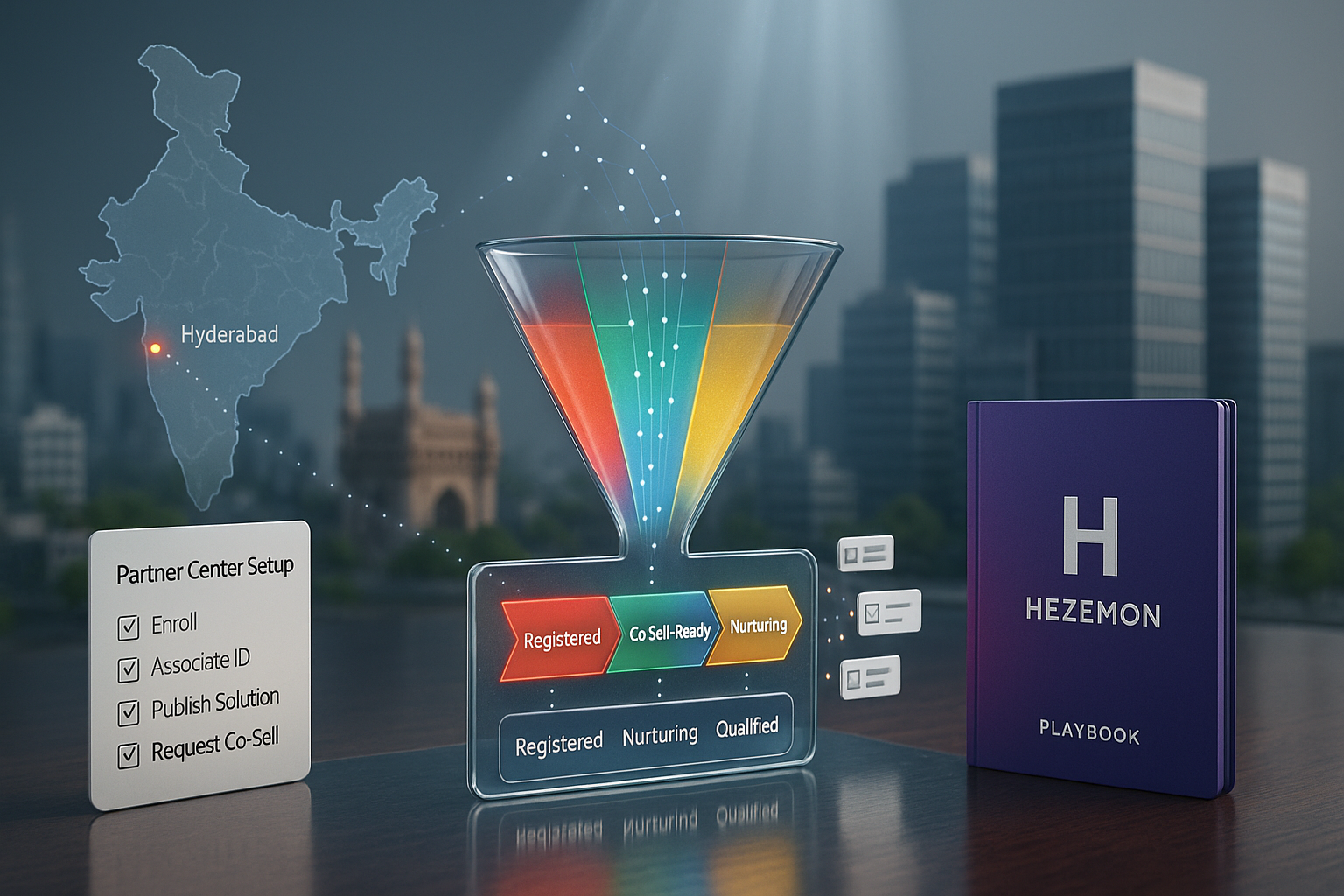
    If you build on Microsoft—Azure, Microsoft 365, Dynamics—co-selling is the fastest way to put your solution in front of Microsoft sellers and their managed accounts. At Hezemon Technologies, we help you go from Partner Center setup to co-sell-ready status, and then convert that visibility into meetings and revenue.

    Why co-sell (and what “co-sell-ready” really unlocks)

    Co-selling exposes your solution to Microsoft sales teams and partner sellers so you can collaborate on deals together. For Azure IP offers, co-sell can also contribute to a customer’s Microsoft Azure Consumption Commitment (MACC)—a powerful incentive inside enterprise accounts.

    Microsoft Office 365 Reseller

    Step 1 — Nail the Partner Center foundations

    Before anything else, your Partner Center account must be in good order: set up legal business info, complete verification, and configure payout and tax profiles. This ensures your offers can publish and transact without delays.

    Hezemon checklist

    • Company legal profile verified (primary contact + legal contact visible)
    • Payout profile and tax IDs added for your publisher account
    • Appropriate roles assigned (so product, marketing, and finance can work in parallel)

    Step 2 — Publish a marketplace offer the right way

    To qualify for co-sell-ready status, your offer must be published live in Microsoft’s commercial marketplace (Azure Marketplace or AppSource). Decide your listing type (listing vs. transactable) and ensure your description and policies meet certification standards. Transactable offers require additional setup by offer type.

    Hezemon tip: If your sales motion depends on frictionless trials or usage-based billing, go transactable early; otherwise start with a high-conversion “Contact Me” listing and move to transact after validation.

    Step 3 — Configure your solution for co-sell inside Partner Center

    Inside Partner Center → Referrals → Co-sell, fill the co-sell solution configuration: elevator pitch, customer value, industries, target geos, reference customers, and sales collateral. This content is what Microsoft sellers see when evaluating fit—and it’s required for co-sell-ready and IP co-sell eligibility.

    digital strategies

    What to prepare

    • One-pager and pitch deck
    • Industry/customer proof (logos or anonymized references)
    • Clear ICP and qualifying questions
    • Deployment architecture (for Azure IP)

    Step 4 — Earn the badges that move sellers

    Microsoft distinguishes between co-sell-ready and incentive-eligible statuses. For Azure IP specifically, Microsoft guidance highlights having a transactable Azure-based offer, passing technical validation, and reaching threshold revenue (e.g., $100K marketplace billed sales or Azure consumed revenue) so sellers can earn quota credit and help customers fulfill MACC.

    Meanwhile, Microsoft’s Marketplace Rewards can be activated in Partner Center (assign a marketing contact, then enable benefits) to access GTM placement, PR, and growth support—useful both pre- and post-co-sell.

    Step 5 — Operate your co-sell pipeline like a pro

    Once your solution is discoverable, manage deals from Partner Center → Referrals. You can create and accept referrals, collaborate with Microsoft sellers, and track stages to closed-won. There’s also bulk CSV upload for high-volume motion, and a Salesforce connector if your team lives in CRM.

    Deal hygiene that wins

    • Speed to engage: Respond to new referrals within 24 hours with next steps.
    • Mutual action plan: Share roles, milestones, and MACC alignment early.
    • Proof-first: Lead with reference architecture and customer outcomes, not features.
    • Attach offers: Where relevant, attach your marketplace offer to the opportunity so it’s easy for sellers to position and for customers to buy.

    Hezemon’s co-sell acceleration framework

    1. Partner Center readiness — We set up roles, legal, and payouts; map who does what and when.
    2. Offer & listing — We craft a listing that converts, aligned to certification policies and the right listing type.
    3. Co-sell solution package — We produce the seller-ready one-pager, deck, and references; configure your co-sell profile.
    4. Go-to-market & rewards — We activate Marketplace Rewards and align content to Microsoft field narratives.
    5. Pipeline ops — We wire Partner Center → CRM, set SLAs, and coach your team on referral etiquette and MACC-aware proposals.

    Results you can expect

    • Faster first meetings with Microsoft-managed accounts through aligned value stories
    • Higher win rates when your offer helps customers realize MACC and gives sellers quota credit
    • Repeatable GTM via Marketplace Rewards placements and co-marketing tracks

    SEO boosters (integrate naturally)

    • microsoft co sell ready marketing playbook — We’ll turn your collateral into a field-friendly narrative that maps to Microsoft sales priorities.
    • partner center co sell registration steps india — Hezemon’s India-based team can complete and validate your configuration end-to-end.
    • generate co sell leads for microsoft partners hyderabad— From our Hyderabad hub, we run targeted campaigns that turn co-sell visibility into qualified pipeline.

    Want Hezemon to take you from “listed” to “co-selling” in weeks—not months? Let’s build your co-sell motion together.


  • HS Code Heatmaps: Turning EU Tariff Data into 2.7× More Qualified Buyer Queries

    HS Code Heatmaps: Turning EU Tariff Data into 2.7× More Qualified Buyer Queries

    Agritech buyers in Europe don’t browse like casual shoppers—they search by specification, regulation, and HS code. When every importer, distributor, or grocery chain procurement team is comparing apples to apples (literally), generic product pages won’t win the click—let alone the conversation. This is the story of how Hezemon Technologies used HS Code Heatmaps, multilingual demand pages, and WhatsApp-by-language routing to generate 2.7× more qualified buyer queries for an Indian exporter—without increasing ad spend.

    The Problem We Walked Into

    • Catalog was beautiful, but invisible to the right keywords buyers actually use (“HS 0713”, “EU MRL compliance”, “organic certificate for pulses”).
    • One-size-fits-all English pages ignored city-level demand and distributor behavior across DACH, Benelux, and Southern Europe.
    • Leads from the website arrived as “Interested, send price list,” with no HS code, volume, or delivery terms—making SDRs slow and follow-ups generic.

    Translation: intent existed, but the site didn’t signal fit or reduce procurement friction.

    Grow Business

    The Playbook: HS Code Heatmaps → City-Level Demand Pages

    Step 1: Map Products to HS Codes (and Variants).

    We created a single source of truth for each SKU family—e.g., chickpeas (HS 0713.20), sesame seeds (HS 1207.40)—including pack sizes, certifications, and MRL notes.

    Step 2: Build Heatmaps from Public Data.

    Using public tariff and import volumes, we mapped country → city clusters where those HS codes showed sustained demand. Hamburg ≠ Munich; Antwerp ≠ Liège. Each cluster informed content, language, and distributor angles.

    Step 3: Generate City-Level Landing Pages per HS Code.

    For every high-intent cluster, we shipped a focused page:

    • Title/H1: “HS 0713 Chickpeas—Importer Guide for Hamburg (Incoterms DDP/DDP Alternatives)”
    • Modules: tariff snapshot, certifications, container loads, port options, “documents you’ll receive,” and WhatsApp in-language CTA.
    • Technical SEO: hreflang for DE/FR/IT/ES, structured data (Product + FAQ), canonical discipline.
    Step 4: Catalog Auto-Localization.

    A headless CMS + translation memory rendered SKUs in German, French, Italian, and Spanish. Unit conversions (kg/tonne), date formats, and certificate names adjusted per locale.

    Step 5: WhatsApp Lead Routing by Language.

    A lightweight middleware detected page language + user preference and sent the inquiry to the right rep (German, French, Italian, Spanish). Response templates included HS code, MOQ, and Incoterms by default.

    grow business

    Step 6: Outreach That Mirrors the Buyer’s Query.

    LinkedIn + email sequences referenced the exact HS page the buyer would care about (“HS 1207 sesame—Antwerp route”), not a generic homepage.

    Results That Matter

    • 7× increase in qualified buyer queries (defined as messages containing HS code + MOQ + Incoterms preference).
    • 38% faster first reply thanks to in-language WhatsApp routing and prefilled context.
    • Bounce rate down 29% on city-level pages vs. generic product pages.
    • Meeting conversion improved as buyers arrived pre-qualified, asking about cartonization, pallets, and documentation instead of “send catalog?”

    Why This Works

    1. Intent Alignment: Buyers type HS codes; your pages must answer in HS codes.
    2. Procurement Confidence: Tariff snapshots + certification modules remove uncertainty that stalls B2B deals.
    3. Local Relevance at Scale: City-level landing pages respect logistics reality (ports, hubs, corridors).
    4. Language = Speed: In-language messaging converts curiosity into specifics—volume, terms, and timelines.

    The Stack (Lightweight, Practical)

    • Headless CMS (component library for HS modules)
    • Translation Memory (keeps terms consistent across locales)
    • Automation (page generation from the HS source of truth)
    • WhatsApp Business API (language-based routing + reply templates)
    • Analytics (GA4, GSC) with “Qualified Query” as a custom event

    Implementation Checklist (Steal This)

    • Build an HS Code × City matrix for your top 10 SKUs.
    • Draft a page template with tariff snapshot, docs list, Incoterms, port options, and FAQ.
    • Wire hreflang and schema before content scaling.
    • Ship four pilot pages (two HS codes × two cities) to validate CTR, time on page, and qualified queries.
    • Turn your best performer into a template, then scale to 20–40 pages.
    • Route WhatsApp by language; include HS code and MOQ in the prefilled message.

    Where Hezemon Fits

    Hezemon Technologies specializes in international digital marketing for exporters, conversion-led websites, and multilingual buyer journeys. Our team blends growth, design, and engineering so exporters don’t just look global—they sell global.


  • Meeting-Room Identity: Build Your B2B Brand Through Decks, Not Ads

    Meeting-Room Identity: Build Your B2B Brand Through Decks, Not Ads

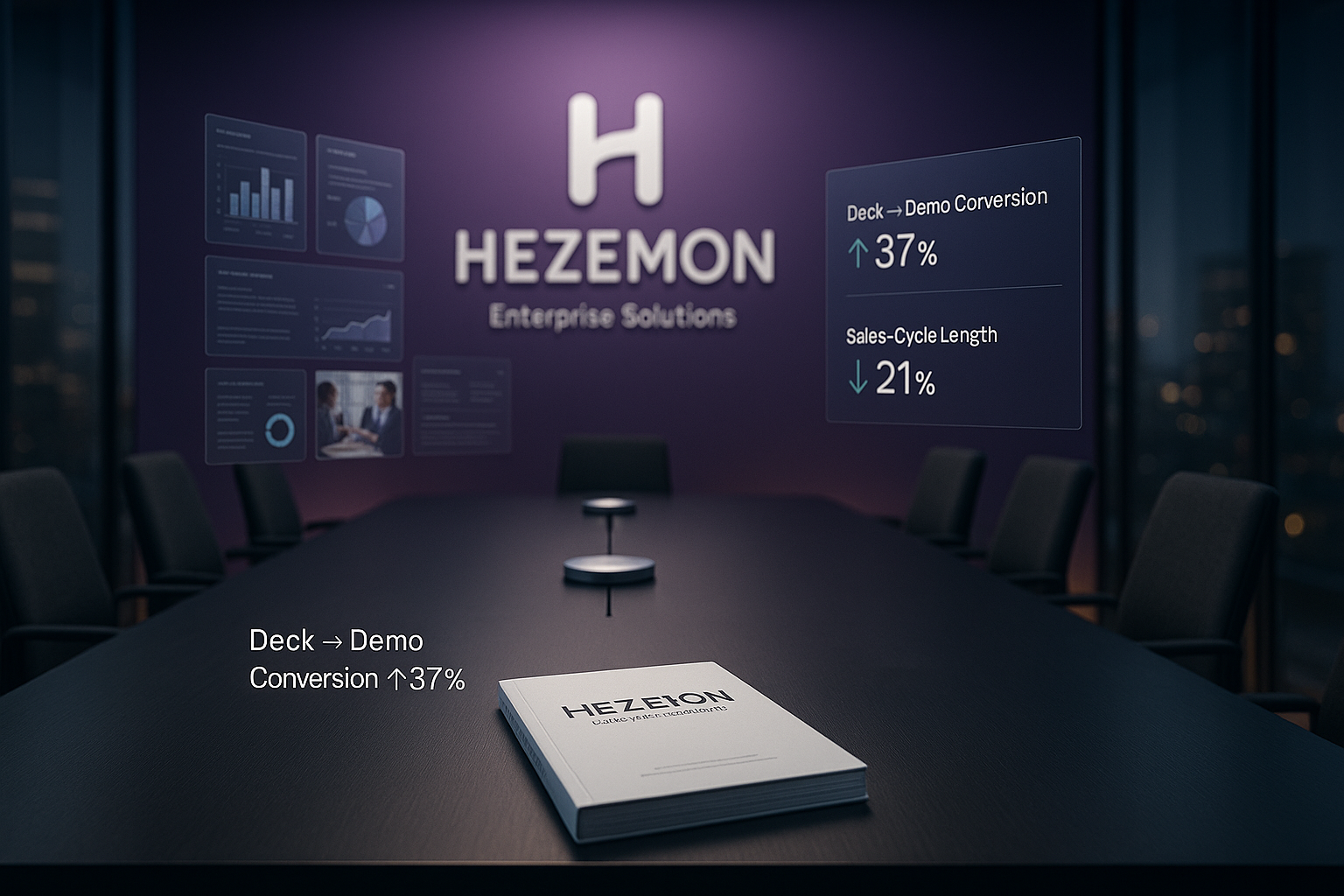
    In enterprise sales, your brand isn’t what the ad says—it’s what the buying committee experiences in the room. Slides, story, proof, and visuals become the operating system of trust. When your “meeting-room identity” is strong, two KPIs move fast: deck-to-demo conversion rises and sales-cycle length falls. Ads can create air cover; decks close the distance.

    Why decks beat ads in enterprise motions

    Enterprise buyers don’t purchase because of a catchy headline. They buy when risk feels managed, value looks provable, and next steps are concrete. That moment happens in a conference room, a Zoom, or a board review—and it’s mediated by your deck. Treat your deck not as a one-off file but as a B2B buying committee presentation framework that maps each stakeholder’s fears to specific proof.

    Grow Business

    The Meeting-Room Identity framework

    1. Narrative spine

    Open with a one-page TL;DR: problem → stakes → desired future → how you deliver → proof → plan. Then let the deck branch into stakeholder-specific annexures.

    1. Persona-layered proof
    • CFO: one slide on ROI math, payback, TCO.
    • CTO/CIO: reference architecture, integration sequence, SLAs.
    • Procurement/Legal/Security: compliance, data handling, DPAs, infosec controls.

    This is where enterprise sales deck templates help: a consistent set for each persona ensures coverage and accelerates customization.

    1. Visual language

    Choose typography, spacing, and iconography that read clearly on a projector and a laptop. Favor contrast, generous margins, and repeatable layouts. Keep charts simple: one idea per chart, labeled directly.

    1. Data-viz rules

    Convert wall-of-text slides into visual comparisons—before/after, swimlanes, and KPI ladders. Define defaults: chart types, axes labels, annotation style. These sales enablement deck design best practices reduce cognitive load for the committee.

    1. Slide metabolism

    An executive reads a deck at ~3–5 seconds per slide in a skim. Title every slide with a conclusion, not a category (“Security posture reduces audit prep by 60%,” not “Security Features”).

    1. Modularity & reuse

    Break the deck into blocks: Vision, Product, Architecture, Proof, Pricing, Plan, Annexures. Give each block a unique code so sales can assemble a deck in minutes without breaking brand.

    Build the system in four sprints

    Sprint 1: Story mining

    Transcribe top sales calls and founder demos. Extract native phrases customers use to describe pain and value. Turn them into your narrative spine.

    Sprint 2: Proof architecture

    List every claim and map a piece of evidence (case study, metric, certification, demo GIF). Prioritize proof that resolves CFO, CTO, and Procurement objections fast.

    Sprint 3: Design system

    Create a library in Figma or PowerPoint: cover variants, section dividers, agenda styles, 12–15 core slide patterns, and a compact icon set. This is your enterprise sales deck templates library—lock styles to prevent drift.

    Sprint 4: Enablement & governance

    Ship a playbook with examples, do/don’t patterns, and a naming/versioning convention. Owners: Marketing (brand), Sales Ops (distribution), RevOps (metrics), Security/Legal (annexures). Train AEs on when to switch from vision mode to proof mode.

    Run the meeting like a product demo

    • Open with the TL;DR. Confirm the problem and outcomes in the first 90 seconds.
    • Branch by signal. If the CFO leans in, jump to ROI; if the CTO asks about scale, pivot to architecture.
    • Proof in context. Show one case study that mirrors their industry/stack.
    • Decide the next slide. End with a “Plan” slide that proposes an evaluation timeline, stakeholders, and artifacts.

    What to measure (and improve weekly)

    • Deck-to-demo conversion: % of first meetings that result in a scheduled demo or deeper technical call. Annotate which slide triggered the pivot.
    • Sales-cycle length: Track cycle time by deck variant; remove slides that correlate with delays.
    • Committee coverage: Count how many stakeholders meaningfully engaged (questions asked, follow-up requested).
    • Slide-level heat: Use read-receipts on PDFs to see time per page; compress or expand accordingly.
    • Reuse index: % of slides coming from the canonical library vs. ad-hoc. Higher reuse = stronger brand coherence.

    Common failure modes (and fixes)

    • Feature floods. Fix: return to the narrative spine; one slide = one conclusion.
    • Pretty but unreadable.Fix: projector-proof your palette; increase contrast and font size.
    • No persona annexures. Fix: build CFO/CTO/Procurement packs; keep them up-to-date alongside your SOC, ISO, GDPR docs.
    • Version chaos.Fix: a single source of truth with locked masters and a change log.

    Mini case vignette (pattern you can replicate)

    A mid-market SaaS team rebuilt its deck into modular blocks with CFO/CTO annexures. Within two quarters, deck-to-demo conversion climbed because reps could pivot to the right proof in under two minutes. Sales-cycle length shrank as Procurement got complete answers from standardized compliance slides. The brand look and feel went from “inconsistent slides” to a confident, repeatable meeting-room identity.

    Your next move

    Turn your deck into a product: documented, versioned, and measurable. Start with the TL;DR slide, assemble enterprise sales deck templates for each persona, enforce sales enablement deck design best practices, and organize everything into a B2B buying committee presentation framework that your whole revenue team can run. Build the brand where decisions are made—in the meeting room—and watch conversions rise while cycle time falls.


  • LinkedIn for Founder-Led Pipeline

    LinkedIn for Founder-Led Pipeline

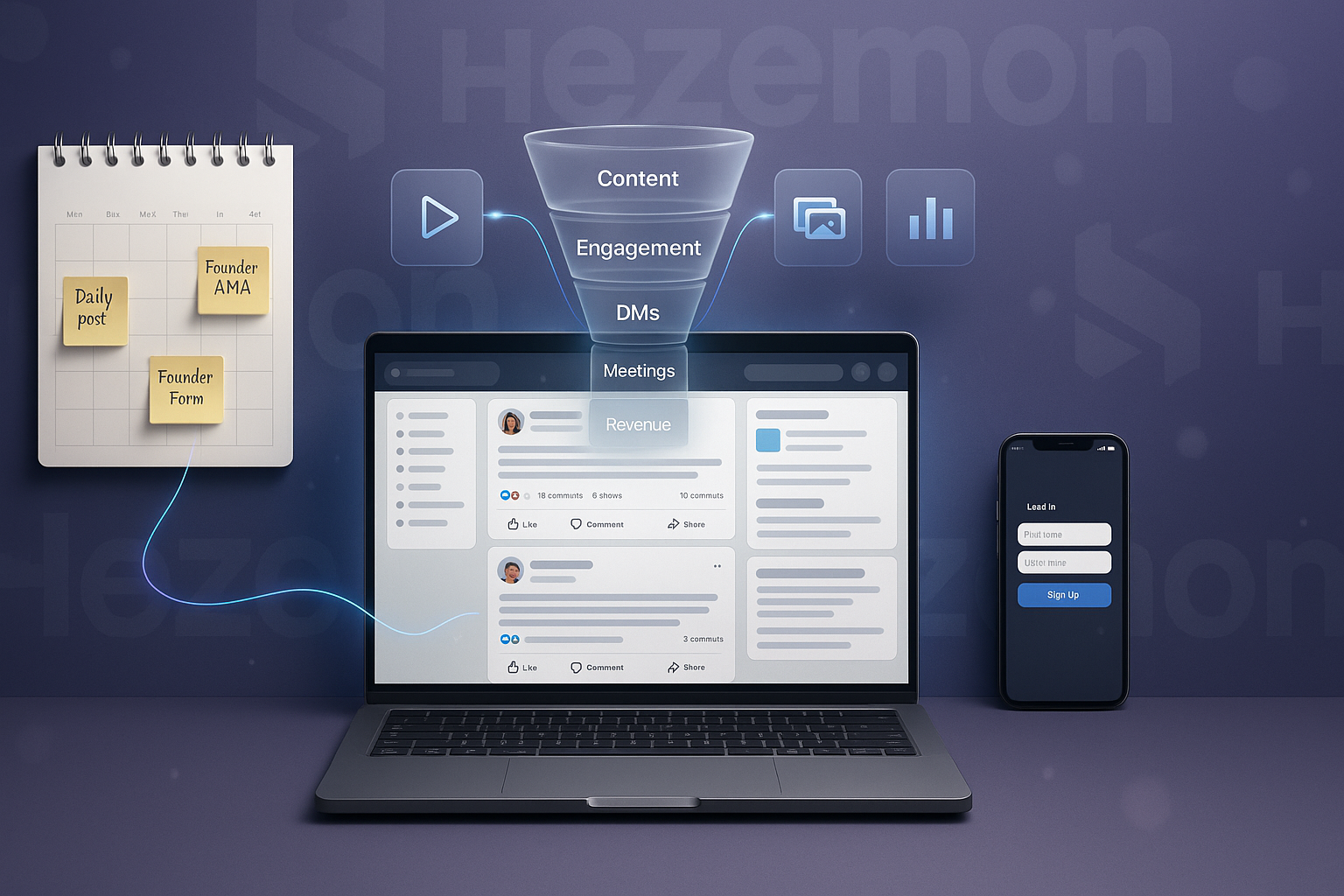
    When founders show up on LinkedIn with a clear point of view, pipeline follows. Not because of hacks, but because buyers trust operators who ship, share, and help. This guide shows how to turn your profile into a steady source of qualified meetings—with a practical linkedin content calendar for founders b2b, real founder brand building on linkedin examples, and actionable linkedin lead gen forms best practices 2025.

    Grow Business

    1) Nail your founder narrative in three moves

    1. Define your ‘earned secret’. What do you know (from building, selling, or supporting customers) that most competitors don’t? Make this your content spine.
    2. Pick two ICP problems and one bold belief. Every post should ladder up to them.
    3. Commit to a cadence. Algorithms reward consistency; buyers reward usefulness.

    Positioning line template: “I help <ICP> achieve <outcome> without <common pain>—by doing <unique approach>.”

    Example: “I help mid-market SaaS CFOs unlock cash-flow accuracy without spreadsheet chaos—by automating quote-to-cash telemetry.”

    2) A lightweight linkedin content calendar for founders b2b

    Use this 4-week, repeatable cadence. It balances proof, POV, and conversation starters. (Repurpose across text, doc posts, and short video.)

    Monday — POV (Hot take + evidence)

    • Hook: Most B2B funnels die because teams chase clicks, not conversations.
      Post:
      We stopped measuring “success” by traffic last quarter and started tracking conversations started per week. Result? Fewer campaigns, higher revenue.
      Clicks don’t book meetings—clarity does. When your content makes a buyer say “that’s my problem,” replies follow.
      Three shifts that worked for us:
    • 1. Wrote problem-first headlines, not features.
      2. Shipped one high-value template per week (with usage rights).
      3. Replied to every meaningful comment within an hour.
      The outcome: same ad spend, +38% meetings, cleaner pipeline. If your team’s drowning in vanity metrics, try a 30-day “conversations only” sprint.
      CTA: Want our conversation-tracker sheet? Comment “tracker”.

    Tuesday — Proof (Mini case / before → after)

    Hook: Before: 1.2% demo rate. After: 4.1% in 21 days.
    Post:
    A mid-market SaaS client struggled with reply rates. We ran a focused sprint:

    • Before → After (3 bullets):
      • 14-step generic drip → 5 targeted emails by persona
      • Feature tour CTA → “15-min problem review” CTA
      • Unqualified list → intent + recent tech changes
      This small reset lifted demo rate to 4.1% and shortened time-to-meeting by 9 days. No fancy stack—just cleaner data and braver copy.
      CTA: Want the 5-email sequence outline? DM “5-step”.

    Wednesday — Teach (How-to / checklist)

    Hook: A 7-step checklist to turn lurkers into pipeline.
    Post:

    1. Write a post that names the problem (not your product).
    2. Offer one practical asset (template, calculator).
    3. Pin a comment with “comment ‘asset’ to get it.”
    4. Log every requester in a sheet.
    5. DM the asset within 24 hours (no pitch).
    6. If they engage, ask one qualification question.
    7. Offer a 15-minute screen share tailored to their use case.
    Repeat weekly. Optimization happens at steps 1 and 5. Your asset is the bridge; your DMs do the selling.
    CTA: Want our DM scripts? Comment “scripts”.

    Thursday — Conversation (Poll)

    Hook: What blocks B2B pipeline the most right now?
    Poll Options:
    • Weak ICP fit
    • No compelling offer
    • Slow follow-ups
    • Data quality issues
    Post copy: Vote and add context in the comments—what did you fix that actually moved meetings? We’ll compile the best answers into a free playbook next week.
    CTA: Drop your fix below; I’ll share our SOP.

    Friday — Founder Log (Behind the scenes)

    Hook: We killed a “great” idea today. Here’s why that’s progress.
    Post:
    We planned a big webinar series. The deck looked sharp. Then we ran a brutal pre-mortem:

    • Who will attend, specifically?
    • What will they do in 24 hours if it’s great?
    • What would make this a waste of time?
      The answers were soft. We scrapped it and doubled down on customer interview clips + short Looms that answer one problem at a time. It’s less glamorous, more useful. As founders, our job isn’t to ship more—it’s to ship what compounds.
      CTA: Want our pre-mortem template? Comment “premortem”.

    Saturday — Community (Shout-out)

    Hook: Shout-out to customers who build with us.
    Post:
    This week, hats off to three teams:

    • A logistics startup that cut RFQ response time by 48% using a simple SOP we co-created.
    • A pharma services team that rewrote their outreach to be HCP-safe and doubled reply quality.
    • A fintech ops crew that turned audit updates into a steady lead source.
      You did the hard work—we just brought structure. If you’ve shipped something you’re proud of this week, tag your team so we can celebrate with you.
      CTA: Drop your win; we’ll feature a few next week.

    Sunday — Recap (Carousel / summary post)

    Hook: Week in 7 cards: what worked, what didn’t.
    Post (slide prompts):

    1. Theme: Conversations > clicks (why it changed our targeting).
    2. Metric: +38% meetings from problem-first content.
    3. Tactic: 5-email persona sequence (outline).
    4. Asset: DM scripts that earn replies.
    5. Decision: Webinar canceled → micro-Looms shipped.
    6. Community: Three customer wins worth studying.
    7. Next Week: Live teardown of 3 ICP landing pages—want yours reviewed?
    Caption: Save this and share with your team on Monday.
    CTA: Comment “teardown” if you want your page on the list.

    Tips to keep this linkedin content calendar for founders b2b realistic:

    • Batch 60 minutes on Sunday to outline five prompts.
    • Keep a running “clip file” of customer questions—they’re your next posts.
    • End each post with a specific CTA: “Want the full checklist? Comment ‘checklist’.”

    3) Credible founder brand building on linkedin examples

    Steal these formats and adapt:

    1. a) The Field Note (SaaS founder)

    Hook: “Three pricing experiments that backfired—and the one that doubled ARPU.”

    Body: list the misses (with numbers), then the keeper and why it worked.

    CTA: “DM ‘pricing memo’ for the spreadsheet.”

    1. b) The Decision Memo (Logistics/Manufacturing)

    Hook: “We rejected a ₹48L deal last week. Here’s why saying ‘no’ saved 1.2Cr.”

    Body: criteria, risk analysis, and alternative play you took.

    CTA: “Want the decision rubric? Comment ‘rubric’.”

    1. c) The Customer PSA (FinTech/Services)

    Hook: “Stop sending 27-field RFPs. Ask these 5 questions instead to cut evaluation time by 40%.”

    Body: five precise questions, each tied to a measurable outcome.

    CTA: “Reply ‘RFP’ for a one-page template.”

    These **founder brand building on linkedin examples** work because they are specific, number-backed, and give away process—not platitudes.

    4) DM & meeting flow that feels natural

    1. Post → Comment capture. Offer a resource (template, checklist).
    2. DM within 24 hours.
    • Message 1: “As promised, here’s the checklist. Curious—are you tackling <problem> this quarter?”
    • Message 2 (only if they engage): “If helpful, I can show how <customer> shaved 18 days off <process>. Worth a 15-min screen share?”
    1. Calendar link last. Ask first, link later—keeps it human.

    5) linkedin lead gen forms best practices 2025

    Lead Gen Forms still convert, but 2025 rewards trust, speed, and post-submit orchestration:

    • 1-Click Value Exchange: Pair every form with a concrete asset (calculator, audit, template). “Demo” alone underperforms.
    • Shortest path wins: Name + Work Email + Role. Use custom questions sparingly; move qualification to follow-up.
    • Native + Nurture Combo: Run the ad to a Lead Gen Form and auto-send a thank-you with the asset. Then trigger a same-day founder email: “Here’s the working file + 2 lines on how to adapt it to <industry>.”
    • Mobile first: Test on 5.5–6.7” devices; avoid long option lists.
    • Routing & SLAs: Pipe to CRM with UTM + campaign naming; assign owners; commit to a 2-hour follow-up SLA.
    • Consent clarity: Plain-language opt-in; link to your policy; honor unsubscribe promptly.
    • Creative that educates: Carousel with 3 frames of the asset, not stock art; a 15-second founder voiceover beats agency polish.
    • Measure what matters: Form fill rate, cost per qualified lead, meeting rate, and opportunity rate. Optimize to meetings, not CTR.

    Summarize these as your internal “linkedin lead gen forms best practices 2025” checklist so the whole team executes consistently.

    6) Metrics that build a flywheel

    • Weekly: Profile views, saves, comments from ICP titles, DM reply rate, new meetings.
    • Monthly: Posts → DMs → Meetings → Stage-1 Opps → Revenue.
    • Qualitative: Which angles triggered real questions on calls? Double down on those topics next month.

    7) How Hezemon can help (and what to DIY)

    • You do: Founder POV, weekly drafts, 15-min video notes we can transcribe into posts.
    • Hezemon does: Editorial calendar, design carousels, campaign setup, LinkedIn Lead Gen Form plumbing, CRM routing, and analytics dashboards. We’ll also tailor the founder brand building on linkedin examples to your industry so they feel native—not generic.

    Quick start in 7 days

    1. Publish three POV posts and one mini case.
    2. Offer one high-value template with a Lead Gen Form.
    3. Message every engager with a useful follow-up.
    4. Book five 15-minute discovery calls.

    Founder-led doesn’t mean founder-alone. With a clear linkedin content calendar for founders b2b and disciplined linkedin lead gen forms best practices 2025, your LinkedIn presence becomes a pipeline engine—on your terms. If you’d like, Hezemon can turn this playbook into your next 30-day plan.

  • GxP-Ready Pharma Websites: Medical Content Governance, HCP Portals, and Multilingual Compliance

    GxP-Ready Pharma Websites: Medical Content Governance, HCP Portals, and Multilingual Compliance

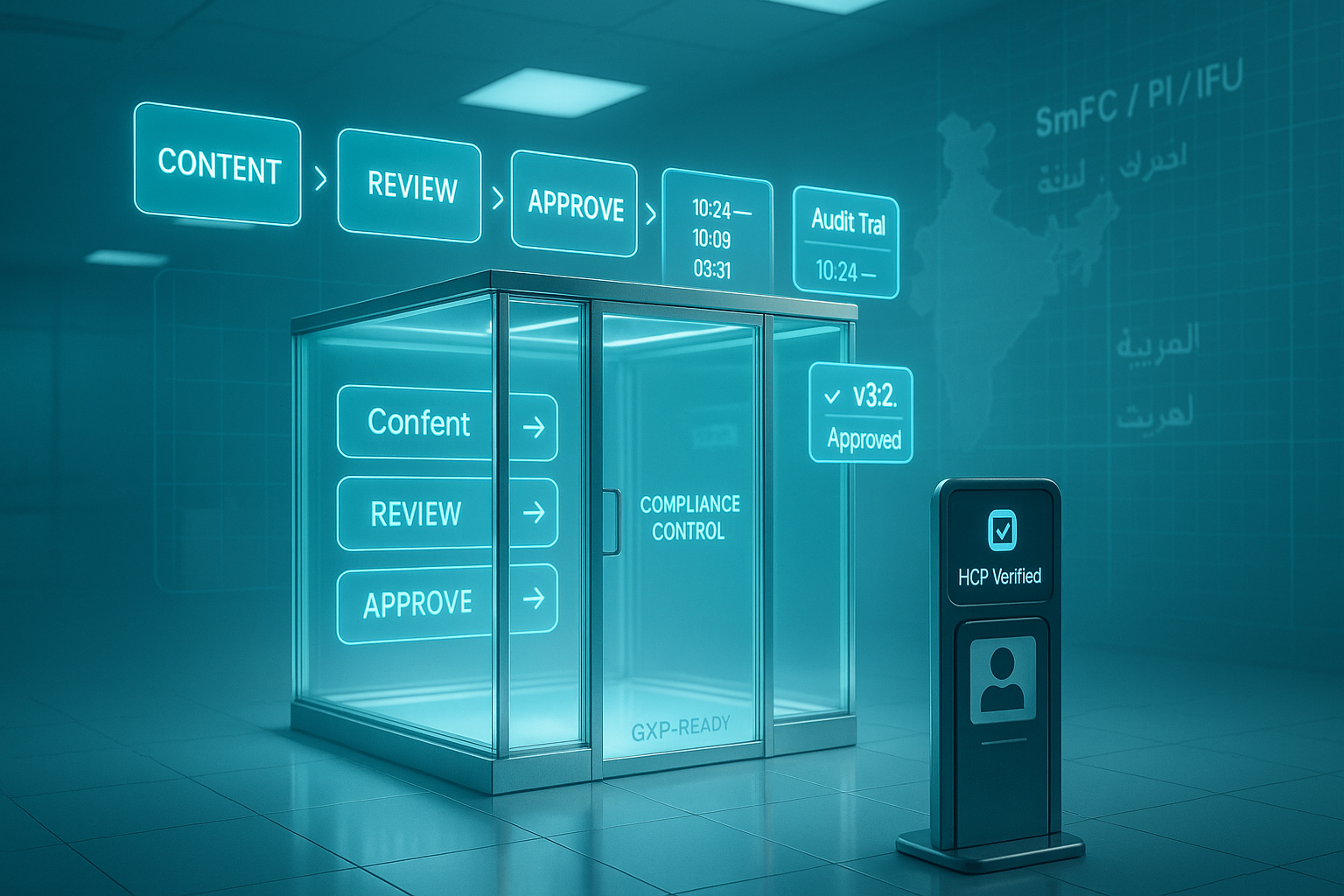
    In life sciences, a website is more than marketing—it’s a regulated touchpoint. If you sell to hospitals, labs, or prescribers, your digital estate must be fast, trustworthy, and inspection-ready. At Hezemon, we build for that reality. This guide explains how we approach pharma website development India with three pillars: medical content governance, hcp portal design guidelines, and the foundations of a gxp compliant medical website—so you can launch quickly without risking quality or compliance.

    Grow Business

    Pillar 1: Medical content governance (built for MLR)

    A gxp compliant medical website needs a provable chain of custody for every claim, PDF, and page. Our governance model for pharma website development India includes:

    • MLR workflow: Medical, Legal, Regulatory stages with required approvals and e-sign checkpoints; re-review on any change.
    • Versioning + audit trails: Who edited what, when, and why; rollbacks in one click; immutable logs.
    • Claims & references library: Centralized statements mapped to peer-reviewed sources; automatic “last-reviewed” and “expires on” banners.
    • Labeling & safety updates: Templated sections for indications, contraindications, black-box warnings, and PI/SMPC links, synced to latest packs.
    • Content expiry + alerts: Timers for HCP assets, patient leaflets, and promo materials to prevent outdated claims.

    Result: your gxp compliant medical website can show regulators clear evidence of control—without slowing the marketing team.

    Pillar 2: HCP Portals that clinicians actually use

    Strong hcp portal design guidelines make or break engagement. For pharma website development India, we standardize:

    • Identity & access: HCP verification (license/registration), SSO options, and 2FA.
    • Role-based content: Differentiate physicians, pharmacists, and payors; surface the right assets (clinical papers, dosing tools, formulary kits).
    • Micro-journeys: CME modules, sample requests, rep scheduling, and congress resources—each with consent and audit capture.
    • Contextual search: Synonyms, drug names, and MOA terms tuned for medical language; zero-results fallbacks.
    • Data minimization: Only collect what’s necessary; explicit purpose notices; downloadable consent records.
    • Performance + UX: Sub-second navigation on low bandwidth, dark-mode friendly charts, WCAG 2.2 accessibility.

    We encode these hcp portal design guidelines into design systems and component libraries so every new brand or molecule inherits best practices by default.

    Pillar 3: Multilingual and market-ready (India first, global next)

    For pharma website development India, multilingual isn’t just translation—it’s regulatory nuance. Our approach:

    • Terminology control: Translation memory + glossary for dosage forms, indications, and adverse events; no “creative” synonyms.
    • Layout resilience: UI that handles word-expansion and Indian scripts (hi-IN, te-IN, ta-IN, bn-IN) without breaking.
    • Localized disclaimers: Region-specific risk statements and approval statuses; clear distinction between HCP and patient spaces.
    • Date/number formats: Prevent decimal/units confusion in dosing tables and calculators.
    • Workflow parity: The same MLR checkpoints in every language, with per-locale reviewers and time-boxed SLAs.

    These patterns help a gxp compliant medical website stay accurate across languages while remaining fast and consistent.

    Architecture & security: what regulators expect to see

    Whether your stack is headless (CMS + Next.js) or enterprise DXP, we engineer for inspection-readiness:

    • Change control: Dev → Stage → Prod with gated deploys; signed build artifacts; release notes tied to tickets.
    • Data protection: Encryption in transit/at rest, WAF, bot protection, least-privilege access, and regular pen-tests.
    • Event evidence: Page-level and file-level audit logs exportable for QC; uptime and incident history retained.
    • Compliant forms: Purpose-specific consent, one-click withdrawal, and retention policies reflected in the CMS.
    • Validation mindset: Documented UAT scripts for calculators, converters, and interactive MOA; regression suites for safety content.

    This is how pharma website development india aligns with global expectations while respecting local realities.

    Analytics without over-collection

    A gxp compliant medical website must measure outcomes without creeping into PII. We implement:

    • Event taxonomy: Non-identifying events (e.g., “dosing-tool used”) instead of raw text fields; server-side tagging where appropriate.
    • HCP analytics guardrails: Aggregate cohorts, frequency caps on emails, and suppression rules for sensitive segments.
    • Decision loops: Dashboards that tie HCP journeys to content freshness, so MLR can prioritize reviews with the highest clinical impact.

    Hezemon’s delivery model (how we de-risk your launch)

    For clients choosing pharma website development India, we run a predictable playbook:

     1. Discover & define: Regulatory inventory, risk assessment, and architecture blueprint.

     2. Design system: Components pre-baked with hcp portal design guidelines and accessibility tokens.

    3. Content governance setup: MLR workflow, claims library, versioning, and reviewer roles in CMS.

     4. Build & validate: Performance budgets, localization scaffolding, and traceable releases.

    5. Operate & improve: SLA-backed support, scheduled content re-approval, and quarterly compliance audits.

    By institutionalizing governance, you get speed and safety—exactly what a gxp compliant medical website demands.

    Why Hezemon

    Hezemon specializes in pharma website development India for brands that need reliable MLR workflows, practical hcp portal design guidelines, and multilingual rollouts. If you’re planning a new launch or remediation, we’ll turn complexity into a clean, auditable website your medical, legal, and regulatory teams can trust.

    Ready to blueprint your gxp compliant medical website? Contact Hezemon for a free governance and portal review.

  • Unboxing that Converts: Packaging Graphics that Boost Repeat Buys for Subscription Brands

    Unboxing that Converts: Packaging Graphics that Boost Repeat Buys for Subscription Brands

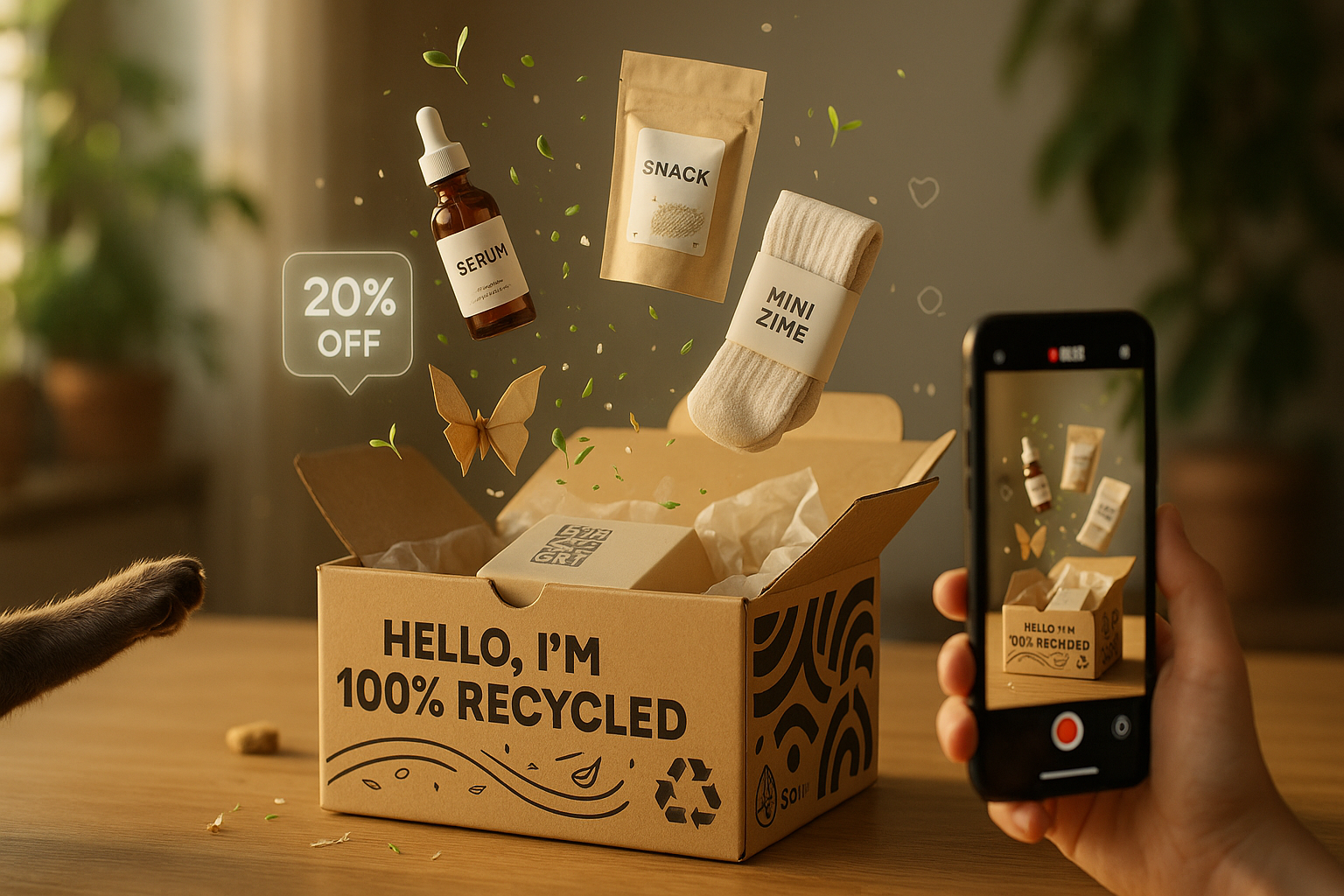
    Why this matters: The 90 seconds after a parcel lands in a customer’s hands can determine your LTV. Treat the mailer as a media channel and you’ll turn first-time buyers into repeat loyalists—and every doorstep into a mini content studio. At Hezemon, we help brands engineer that moment with smart subscription box packaging design, purposeful storytelling, and measurable unboxing experience design—all wrapped in eco-friendly packaging graphics your customers feel proud to share.

    Grow Business

    The conversion science behind the unboxing moment

    Unboxing is not just aesthetics. It’s a structured path from anticipation → discovery → activation:

    1. Anticipation (outside the box): Signal value on arrival. A distinct color block, brand mark, and a promise line prepare the mind for delight. This is where subscription box packaging design sets expectations before the first cut of the tape.
    2. Discovery (inside the box): Sequential reveals—tissue → printed inner lid → hero product—reduce cognitive load and heighten emotion. Crisp unboxing experience desig* organizes the order of delight so nothing competes for attention.
    3. Activation (after the reveal): A tiny nudge turns joy into action—share, reorder, refer. Thoughtful eco-friendly packaging graphics can include short reuse instructions (“peel, fold, plant”) that feel good and get talked about.

    The 5-panel packaging canvas (and what each panel should do)

    Treat every surface as a job-to-be-done. This keeps subscription box packaging design intentional, not ornamental.

    1. Top/Lid (hook):

    One big promise: “Refill joy in 30 seconds.” Pair with a scannable code. Keep ink coverage light to support eco-friendly packaging graphics.

    1. Side Panels (identity):

    Rotating benefit blurbs + recycled iconography. Mention material %. This subtle sustainability proof lifts perceived value and aligns to unboxing experience design that respects the planet.

    1. Inner Lid (story):

    A 50–70 word narrative: why the product exists and what to try first. This is prime acreage for subscription box packaging design that guides the very first usage.

    1. Insert/Thank-you (action):

    One CTA only—“Tap to reorder with 1 click,” “Gift a friend for 20% off.” Your unboxing experience design should minimize steps between delight and repurchase.

    1. Base (reuse + UGC):

    Simple diagram: “Cut along the dotted line to turn this into a desk tray.” Add “Share your tray: #MyHezemonBox.” Sustainable reuse drives shares and justifies eco-friendly packaging graphics choices.

    UGC engine: turn mailers into media

    UGC happens when you make sharing easier than not sharing. Build that into the unboxing experience design:

    • Printed prompts: “Snap your first sip!” / “Show us where it lives on your shelf.”
    • Framing marks: Minimal corner guides inside the lid to line up the perfect flat-lay.
    • QR to story flow: QR opens a pre-filled camera/story template.
    • Micro-incentive: “Monthly draw for best setup—no post required, stories count.”
    • Creator credit: Feature customers on a public gallery; print a tiny URL on future runs. This reinforces subscription box packaging design as a community touchpoint.

    Eco choices that sell (and tell)

    Sustainability isn’t a footnote—it’s part of the pitch. Customers re-buy when they feel aligned with your values.

    • Materials: FSC-certified kraft, 30–70% post-consumer content. Print these facts directly; they are your eco-friendly packaging graphics.
    • Inks & finishes: Water-based inks, soy alternatives, and minimal lamination. Matte kraft + spot white can look premium and planet-first.
    • Right-size fit: Smart dielines reduce void fill and shipping cost—an unsung hero of subscription box packaging design.
    • End-of-life clarity: “Recycle box, compost tissue, keep insert.” Clear icons are part of good unboxing experience design and prevent wish-cycling.

    Copy cues that move people to buy again

    Tight copy on the right surface outperforms long prose.

    • Top: “Refills, ready when you are.”
    • Inner lid: “Start with the [hero item]. 10-second setup inside.”
    • Insert: “Reorder in one tap: scan → confirm. Ships tomorrow.”
    • Base:“This box becomes a desk tray—flip + fold. Show us: #MyHezemonBox.”

    Each line earns the right to be printed. If it doesn’t drive use, share, or repeat, it doesn’t ship.

    Measure what matters (and iterate by print run)

    Your box is a testable asset. Bake tracking into the unboxing experience design.

    • Reorder scans per 100 boxes (unique QR with UTM by print batch)
    • UGC rate (posts/stories tagged ÷ boxes shipped)
    • Return rate delta (compare “with insert” vs “without insert” cohorts)
    • Time-to-second purchase (lift vs. previous packaging)
    • Sustainability mentions (count qualitative references to eco-friendly packaging graphics in reviews/DMs)

    Report these alongside CAC/LTV to prove packaging’s revenue role.

    Mini-case: 60-day redesign for a grooming subscription

    A D2C grooming brand engaged Hezemon to overhaul subscription box packaging design. We simplified the outside, added a one-tap reorder insert, and rewrote the inner-lid microcopy to guide first use. We also introduced eco-friendly packaging graphics with recycled content badges and a reuse fold for a razor stand. Outcomes in 60 days:

    • +31% reorder QR scans
    • +22% UGC volume (stories over posts)
    • –14% damaged-in-transit (right-sized dieline)
    • +9% lift in repeat within 45 days

    Small changes in unboxing experience design drove big behavioral shifts.

    Hezemon’s quick-start checklist

    • One promise on the lid (no more)
    • Inner-lid story <70 words, action-led
    • Insert with a single CTA + unique QR
    • Reuse diagram on base (easy + photogenic)
    • Material + ink disclosures as eco-friendly packaging graphics proof
    • Batch-level tracking (UTMs per print run)
    • Quarterly review of subscription box packaging design variants

    Final word (and a simple next step)

    Your next growth lever might not be a new ad—it could be a smarter box. When subscription box packaging design guides usage, when unboxing experience design removes friction, and when eco-friendly packaging graphics make customers proud, repeat buys become a habit and UGC becomes free reach.

    Want a 7-day Packaging Audit and a print-ready insert you can test next month? DM Hezemon with “UNBOX” and we’ll share our template pack and a mini roadmap for your next print run.


  • Headless, Fast, and Trackable: Building Real-Time Client Portals for Logistics Companies

    Headless, Fast, and Trackable: Building Real-Time Client Portals for Logistics Companies

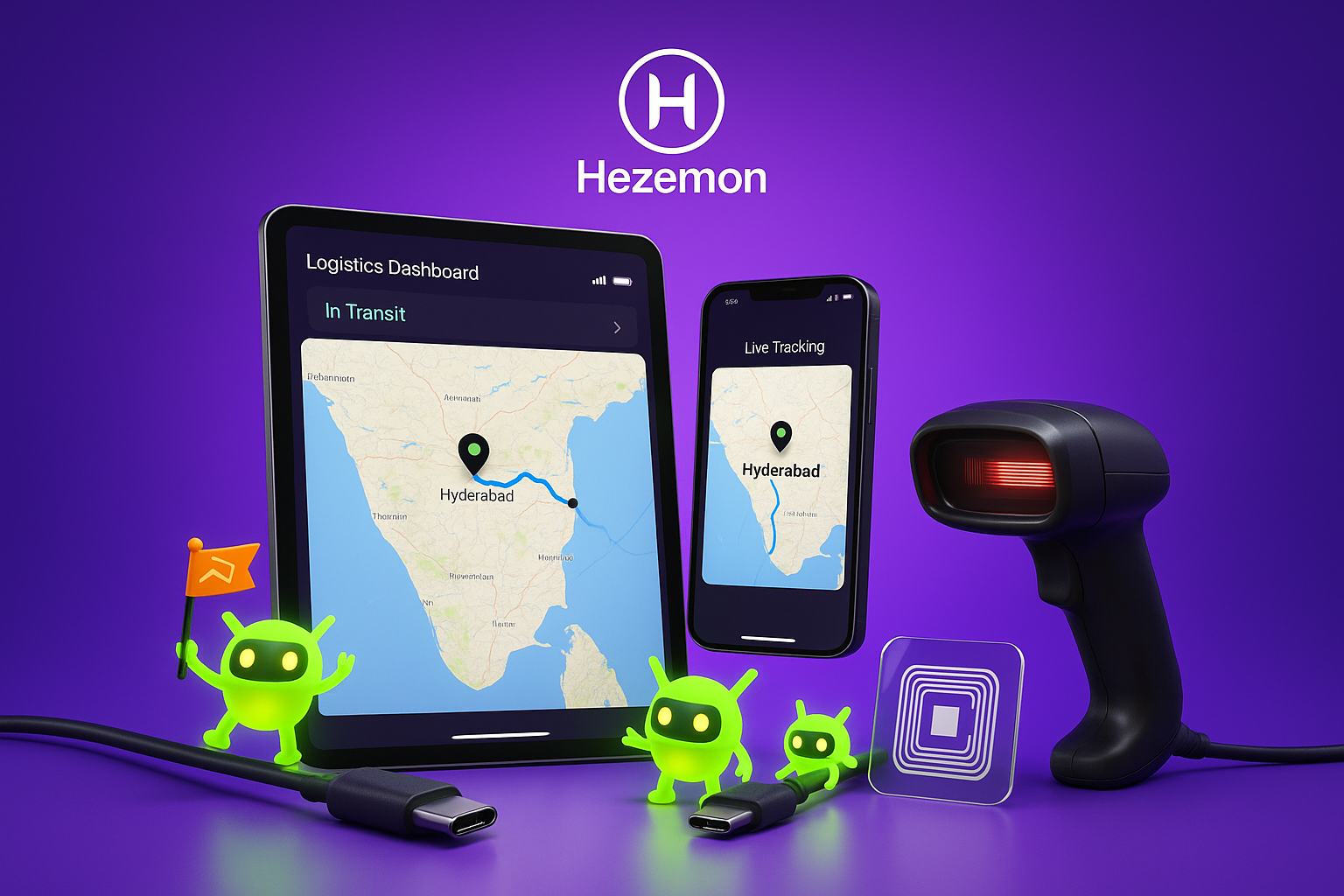
    Shippers don’t want another brochure site—they want answers: Where is my consignment? What’s the ETA? Where’s the PoD? That’s why forwarders and 3PLs in Telangana are prioritizing logistics website with live tracking development Hyderabad projects that deliver real-time visibility, self-service documents, and proactive alerts. The most reliable way to ship this quickly—and scale across branches and partners—is to decouple content from data with a headless CMS for 3PL websites India. Pair that with a robust API layer and you’ll have the foundation for high-speed B2B client portal development for logistics Hyderabad that actually moves the needle.

    Grow Business

    Why headless wins for logistics

    Legacy, page-builder-style sites can’t keep up with fast-changing ops. A headless CMS for 3PL websites India separates your front end (React/Next.js) from content APIs, letting marketers publish service pages, tariffs, FAQs, and alerts without touching code, while engineers focus on tracking, orders, and billing. For multi-branch networks and agent models, this unlocks faster localization and brand control. Most importantly, headless plays nicely with TMS/WMS, telematics, and ERP connectors—the core of any B2B client portal development for logistics Hyderabad initiative.

    Real-time tracking that reduces WISMO

    The heart of a logistics website with live tracking development Hyderabad build is a single source of truth for shipments. Unify GPS/ELD pings, driver app events, and geofences into a timeline that anyone—shipper, consignee, finance—can understand. Display live location on a map, stop-level ETAs, dwell time, and exception flags (delay, diversion, temperature breach). Trigger WhatsApp/SMS/email notifications at pickup, in-transit, exception, out-for-delivery, and delivered. These features lower “Where is my order?” calls by 30–50% and make your portal the first tab a customer opens every morning.

    The reference stack (proven and practical)

    For dependable B2B client portal development for logistics Hyderabad, use a simple, scalable pattern:

    • Front end: Next.js for fast SSR and smooth client transitions
    • Content: A headless CMS for 3PL websites India with models for lanes, services, surcharges, and help docs
    • APIs: microservices for tracking, orders/documents (PoD, invoices), and notifications
    • Data: relational DB for transactions; analytics store for lane performance and SLA reports
    • Security: OAuth2/SSO, role-based access (shipper, consignee, branch, partner), signed URLs for documents

    This keeps the UI blazing while your ops team keeps adding routes, agents, and value-added services without re-deploys—exactly what a logistics website with live tracking development Hyderabad needs.

    The 90-day rollout plan

    Weeks 1–2: Discovery & KPIs. Align on SLAs (on-time %, response time), data sources, and the MVP: live tracking, shipment search, PoD visibility. Confirm the headless CMS for 3PL websites India so marketing can start structuring content now.

    Weeks 3–6: Foundations. Build auth and RBAC, wire the tracking aggregator, render a live map with event timelines, and ingest historic shipments for context. Publish core service pages through the CMS. Your B2B client portal development for logistics Hyderabad now has a usable spine.

    Weeks 7–10: Self-service workflows. Add rate-quote to booking, shipment creation, document center (BL/PoD/invoices), and claims intake. Configure WhatsApp/SMS/email triggers. This phase cements your logistics website with live tracking development Hyderabad as a daily driver for customers.

    Weeks 11–13: Analytics & hardening. Dashboards for lane performance, dwell time, exception reasons; load testing; security scans; multilingual content. The headless CMS for 3PL websites India lets you publish localized guides and seasonal surcharges quickly.

    What good looks like (UX essentials)

    • Shipment search that thinks like ops: by reference, PO, consignee, lane, vehicle.
    • Readable milestones: fewer data dumps, more human-friendly statuses.
    • One-click documents: signed URLs for PoD and invoices; no inbox hunting.
    • Predictive ETAs: combine historical lane data with live traffic for fewer surprises.
    • Accessible on the move: responsive design, offline-aware driver flows where needed.

    Nail these and your B2B client portal development for logistics Hyderabad won’t just inform—it will reassure.

    Security, compliance, and reliability

    Freight data is sensitive. Use TLS everywhere, rotate keys, and apply least-privilege access. Keep immutable audit logs for every event and user action. Define RPO/RTO and run quarterly recovery drills. When your logistics website with live tracking development Hyderabad handles cross-border documentation, maintain retention policies aligned to customs and taxation rules. Enterprise buyers will ask; be ready to show it.

    Content velocity = commercial velocity

    Winning lanes requires speed—not just in trucks, but in messaging. With a headless CMS for 3PL websites India, your team can spin up landing pages for new corridors, festival surcharges, value-added services (FTL/LTL, cold chain, white-glove) and localize them for Hyderabad, Vizag, or Pune without developer wait time. More relevant pages mean more high-intent traffic and smoother hand-offs to sales.

    Measuring ROI that matters

    Track outcomes, not pageviews. A well-executed B2B client portal development for logistics Hyderabad typically sees:

    • Fewer WISMO tickets via live tracking and proactive alerts
    • Faster dispute resolution through digitized event trails and PoD access
    • Higher repeat bookings thanks to self-service convenience
    • Lower cost-to-serve as ops spends less time answering routine emails

    When customers log in and stay, the portal is paying for itself.

    The takeaway

    If reliability and speed are your brand, your tech must reflect it. A logistics website with live tracking development Hyderabad powered by a headless CMS for 3PL websites India and clean APIs gives you the agility to serve today’s shipments and tomorrow’s growth. Treat the portal as a product—iterate weekly, publish often, and keep reducing friction. That’s how modern 3PLs turn visibility into loyalty and B2B client portal development for logistics Hyderabad into a durable competitive edge.